
Public Lecture: Measuring the Impossible: How We Detected Gravitational Waves
Event Details:
Location
This event is open to:
About the Lecture
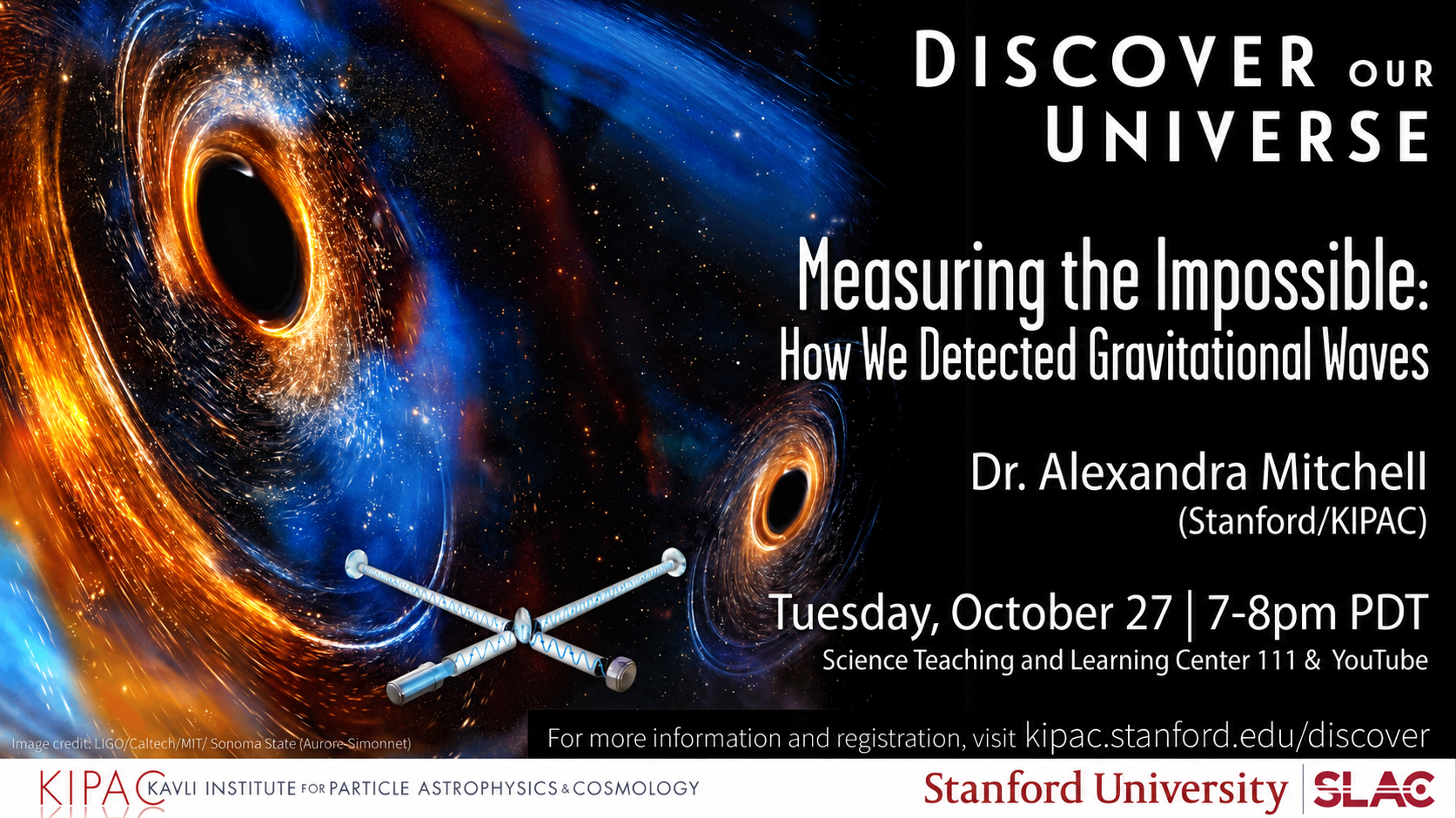
Two black holes collide over a billion light-years away, creating waves in the fabric of spacetime. But by the time those waves reach us, their effect is so small that they would change the light-years of distance by less than the width of a human hair. When Einstein predicted gravitational waves as a consequence of his theory of general relativity, detecting them seemed far beyond what experiments could achieve. Doing so would require an instrument more sensitive than anything ever built before. At this extraordinary level of precision, almost everything gets in the way: ground motion, the thermal vibrations of atoms making up the detector, even the quantum nature of light. In this talk, Dr. Alexandra Mitchell will explore how generations of scientists and engineers turned a measurement that once seemed impossible into one of the great experimental achievements of modern physics. She will also highlight some LIGO’s recent gravitational-wave discoveries and what they have revealed about our Universe, and how researchers are pushing these instruments even further to discover what we haven’t yet been able to see.
Live stream URL can be found at the bottom of the EventBrite registration confirmation email.
About the Speaker

Alexandra Mitchell is an experimental physicist at Stanford University, working on precision instrumentation for gravitational wave detectors such as LIGO. Her primary research focus is development and integration of seismic sensors to improve detector performance, helping us measure signals from a wider range of black holes and neutron stars. Alexandra was drawn to the field by its combination of enormous questions about the Universe with the hands-on challenge of building extraordinarily precise instruments to answer them. She has built and installed technology in research facilities across Europe and the US, and joined Stanford as an NWO Rubicon Fellow in 2025. Outside the lab, Alexandra is a passionate science communicator and uses social media and her podcast Alex the Physicist & Friends to share both the science and the reality of life as a scientist. Through her science communication, she hopes to humanise scientists and make science feel more accessible and relatable.
Directions and Parking
This event will take place in the Sapp Center for Science Teaching and Learning (376 Lomita Dr.), Room 111. Upon arrival, please follow the directional signs and check in at the foyer.
The closest visitor parking is available on Roth Way, Lomita Dr., in the Roth Way Garage, and along the Stanford Oval. All parking is free in spaces marked Visitor, A, or C after 4pm unless indicated otherwise. Accessible parking is also available in the locations listed above.
If you plan to take public transportation, some lines of the Marguerite Shuttle connect the Palo Alto Transit Center and Caltrain stations to campus. You can get to the Science Teaching & Learning Center by taking Line P (drops off at the Stanford Oval) or Line X (drops off at the Grant Building). A complete list of shuttle schedules and route maps can be found here.
Related Topics
Explore More Events
KIPAC Seminar: Large-scale structure between peaks - modeling the intergalactic medium for the next generation of cosmological datasets
Jamie Sullivan (MIT)Campus, Varian 206-Campus, Varian 206KIPAC Tea Talk: Model-Independent Measurements of Baryon Feedback with kSZ and Galaxy-Galaxy Lensing
Henry Liu (UC Berkeley)Campus, PAB 102/103-Campus, PAB 102/103Astrophysics Colloquium: Probing the physics of the early universe with pulsating stars
Earl Patrick Bellinger (Yale University)SLAC, FKB 3rd Floor Conf. Rm.-SLAC, FKB 3rd Floor Conf. Rm.