Overview
This is an exciting time in the scientific investigation of the universe and its constituents. The study of the very large has joined the study of the very small as a source of fundamental answers — and deep mysteries — in physics and astronomy.
On the smallest scales, cosmic rays interact with Earth’s atmosphere at energies far exceeding what our particle accelerators can achieve. Yet, we do not fully understand the mechanism of these accelerations — in gamma-ray bursts, supernovae, and various stellar remnants.
On intermediate scales, white dwarf stars, neutron stars, and black holes tantalize us. These ultra-dense “compact objects” can produce jets of matter and energy that may be responsible for the ubiquitous cosmic rays and are laboratories for other “extreme” physics.
On cosmic scales, the mysteries of dark matter and dark energy deeply challenge us. Dark matter binds the larger cosmic constituents—galaxies and galaxy clusters—while dark energy drives galaxies and clusters apart with ever-greater speed.
Finally, all these studies come together to inform our understanding of structure and evolution on the grandest scale. Exquisitely careful analysis of the microwave background reveals deep secrets of the early universe -- in the period just after the Big Bang.
KIPAC was founded in 2003 to explore these new fronts and challenges in astrophysics and cosmology. We bring the power of theory, computation, experiments, and observations to bear on these questions. We are a broad community of roughly 200 scientists with diverse interests in astrophysics and cosmology. Our efforts are organized as the Kavli Institute for Particle Astrophysics and Cosmology, or KIPAC, one of 15 independent laboratories, centers, and institutes of Stanford University. Initiated with a generous grant from Fred Kavli and The Kavli Foundation, KIPAC is housed at Stanford in the Physics & Astrophysics and Varian Physics buildings, and at the SLAC National Accelerator Laboratory in the Fred Kavli Building.
From the Director
Dear friends and colleagues,
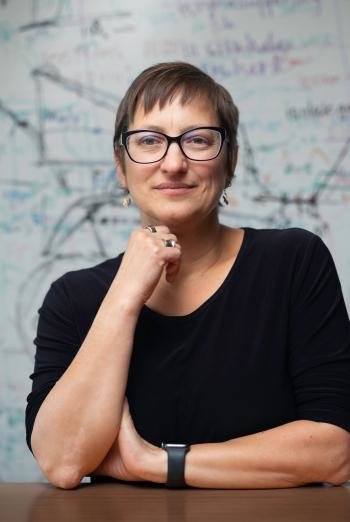
KIPAC was founded in 2003 to bridge the disciplines of astronomy, astrophysics, cosmology, and particle physics and to serve as a bridge between the vibrancy of Stanford University and the unique capabilities of SLAC National Accelerator Laboratory. We have roughly 200 faculty, staff, postdocs, and students engaged in the biggest questions about how the Universe works. What is the Universe made of, and how does it evolve from the earliest moments to the present day? What are the laws of physics governing the Universe and the objects in it? How do galaxies, black holes, stars, and planets form, function, and evolve?
This is an incredible time to have the privilege to ask and begin to answer these questions. KIPAC researchers have recently put new limits on the nature of dark matter and dark energy, characterized the properties of extrasolar planets around hundreds of nearby stars, and made discoveries about black holes and gamma-ray bursts. The next few years promise to be even more exciting as KIPAC scientists design and build new instruments and develop new ways to explore our Universe and the physics that drives us.
The strength of KIPAC comes from our community, including the fantastic ideas of our faculty, staff, postdoctoral fellows, and students, as well as from the ways we learn from each other to innovate and develop new directions. It also comes from engaging with the broader community, with regular visitors who bring new ideas and expertise, and through lectures and other activities that engage the general public.
The Universe is full of surprises, and KIPAC members are excited to have a front seat to discovering them. We hope that you will join us on this incredible journey.
- Risa Wechsler, KIPAC Director