Cal-Bridge Scholars Cap a Summer of Research at KIPAC

Four Cal-Bridge Summer Scholars presented the results of eight weeks of original research at KIPAC this August, the culminating event of a program that has placed students in research internships at Stanford for the past ten years. Many Cal-Bridge scholars transferred from a California community college into a four-year university before joining the program.
Four Projects, Four Corners of Astrophysics
The students — Brooke Berrios (Cal Poly San Luis Obispo), Tahlia Floor (San Diego State University), Rohan Mehta (UC Irvine), and Olive Stam (Cal Poly Pomona) — worked alongside KIPAC faculty, postdocs, and graduate students from June 22 to August 14, tackling questions in galaxy evolution, gravitational lensing, cluster cosmology, and neutrino detector design. Their internships were part of Cal-Bridge, a program that supports students at California State University and University of California campuses — including many who began their academic careers at a California community college before transferring — pairing them with paid summer research placements at institutions like Stanford and giving them hands-on experience in fields where they're often underrepresented. KIPAC has hosted Cal-Bridge scholars every summer for a decade.

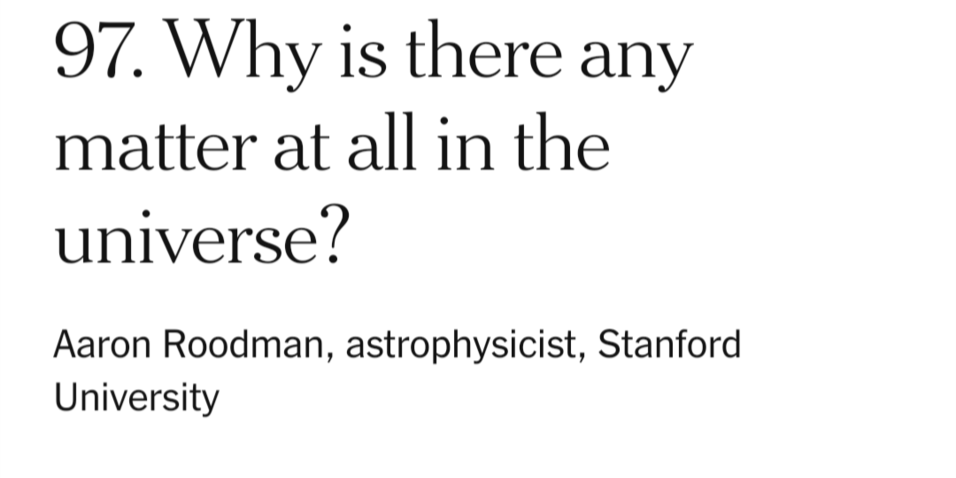
Brooke Berrios, a student at Cal Poly San Luis Obispo working with Steve Allen and Adam Mantz, tackled a problem in galaxy cluster surveys: bright objects at the centers of some clusters can mask the very signal astronomers use to detect them. Using data from the NOEMA interferometer in the French Alps, she worked on a method to model and subtract that contaminating signal, with the goal of uncovering galaxy clusters that current surveys miss entirely (credit: Sanya Gupta, KIPAC).
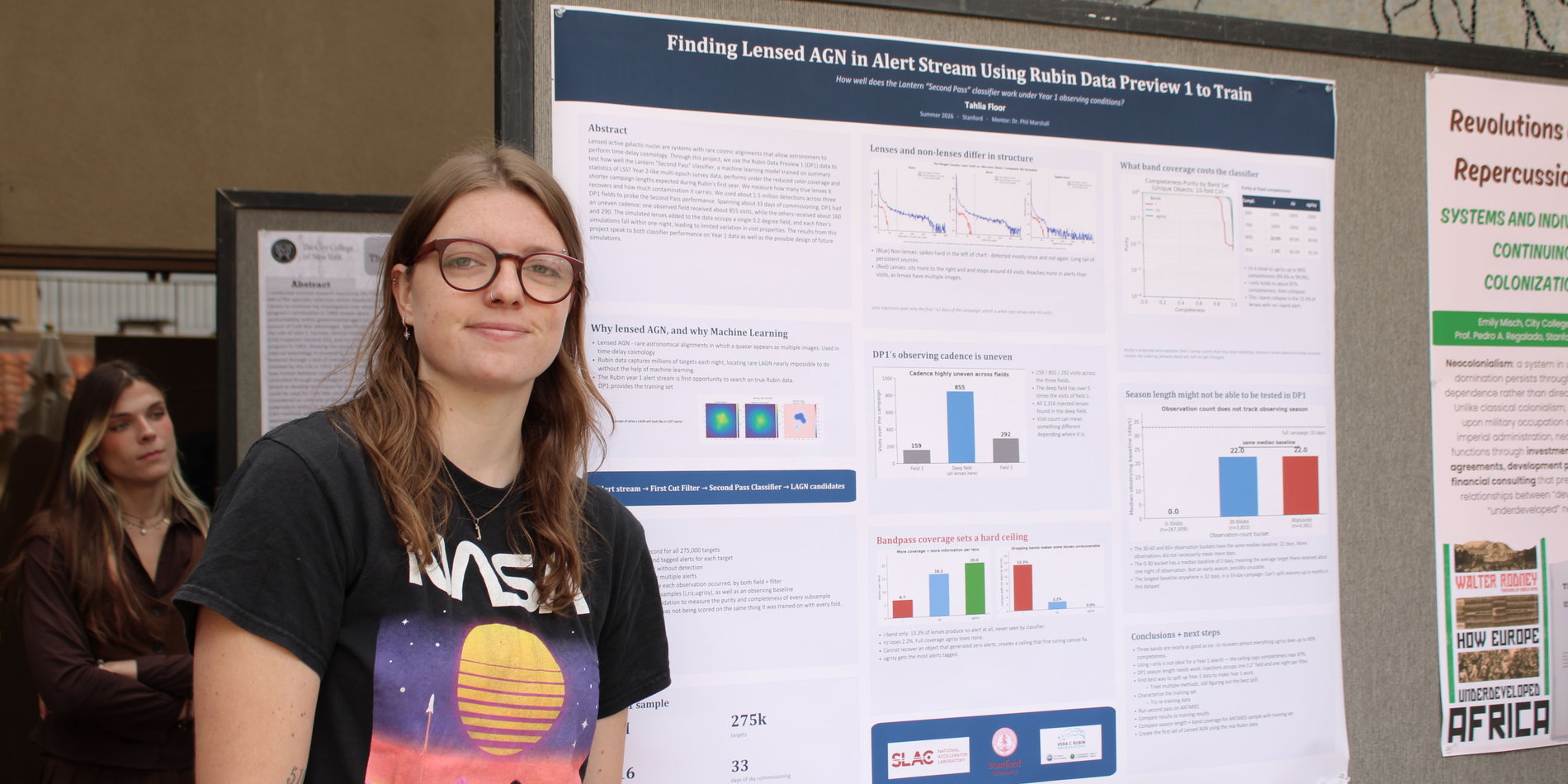
Tahlia Floor, a student at San Diego State University mentored by Phil Marshall and Shunsheng Li, tested a machine-learning classifier's ability to pick out gravitationally lensed quasars — rare alignments where a distant galaxy's light bends around a foreground object — in early data from the Vera C. Rubin Observatory. Lensed quasars are valuable tools for measuring the universe's expansion rate, and Floor's work speaks directly to how astronomers will need to hunt for them once Rubin's full data stream comes online (credit: Sanya Gupta, KIPAC).
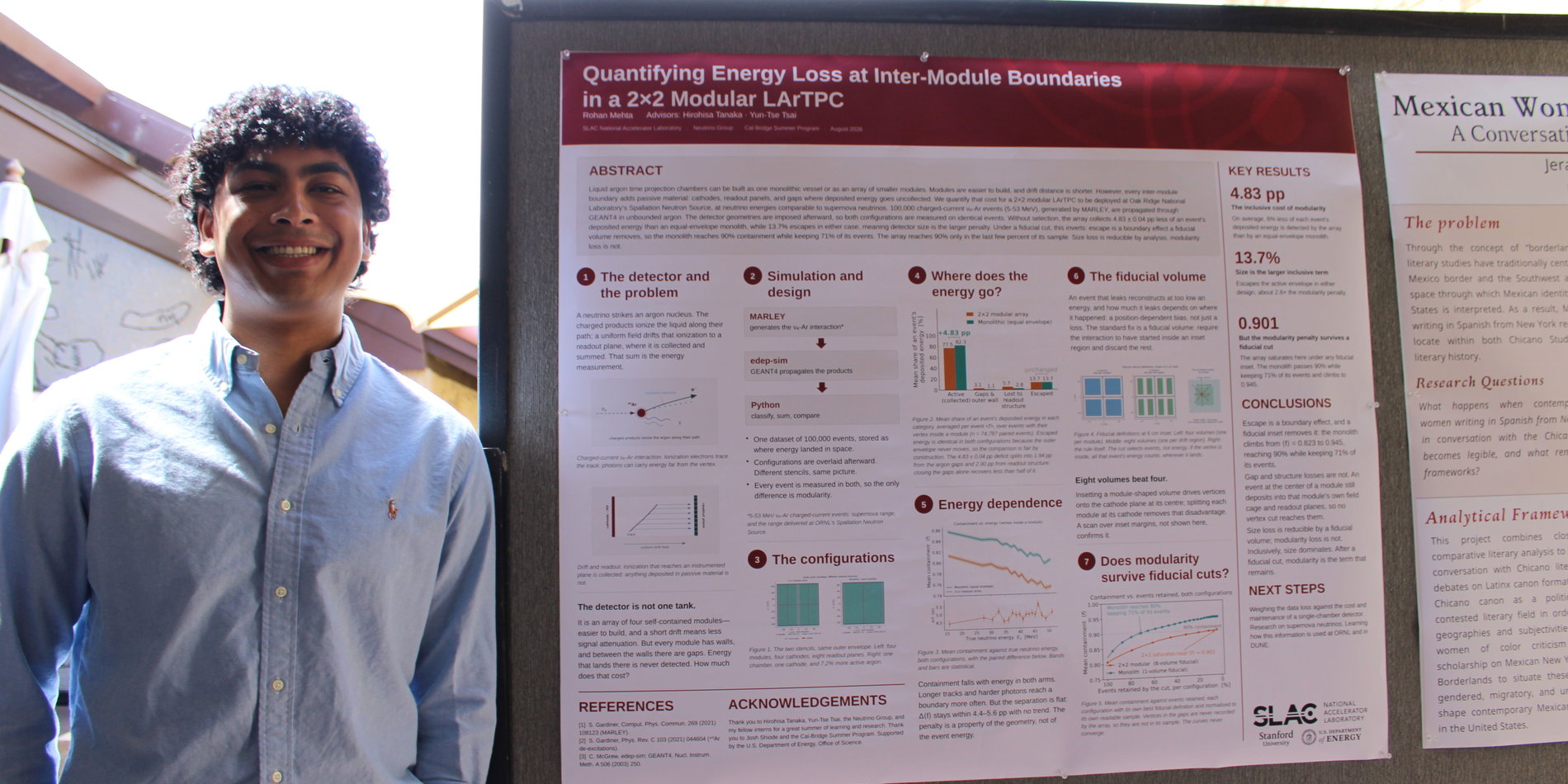
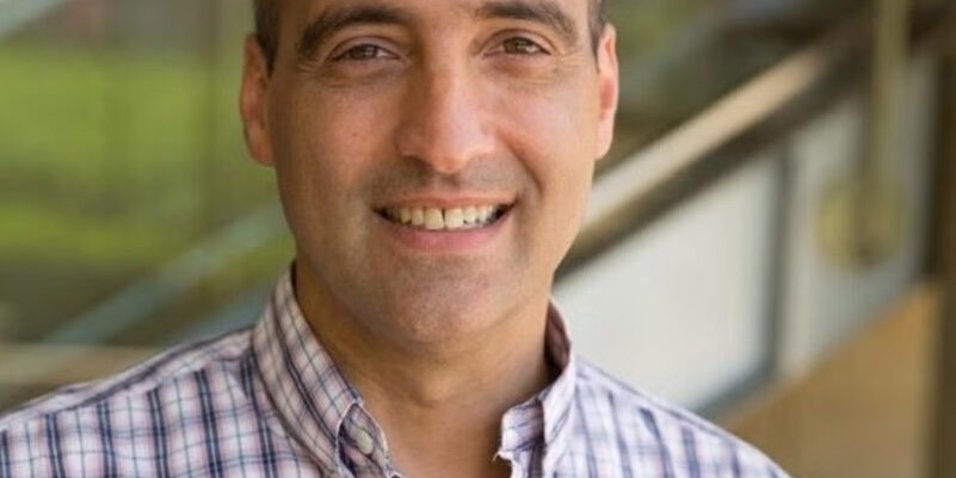
Rohan Mehta, a student at UC Irvine mentored by Hirohisa Tanaka and Yun-Tse Tsai, worked on detector design for neutrino physics. His project quantified how much energy is lost at the internal seams of a modular liquid argon detector — a design being developed for deployment at Oak Ridge National Laboratory's Spallation Neutron Source — compared to a single, unified detector chamber, helping inform trade-offs between ease of construction and data quality in future detector designs (credit: Sanya Gupta, KIPAC).
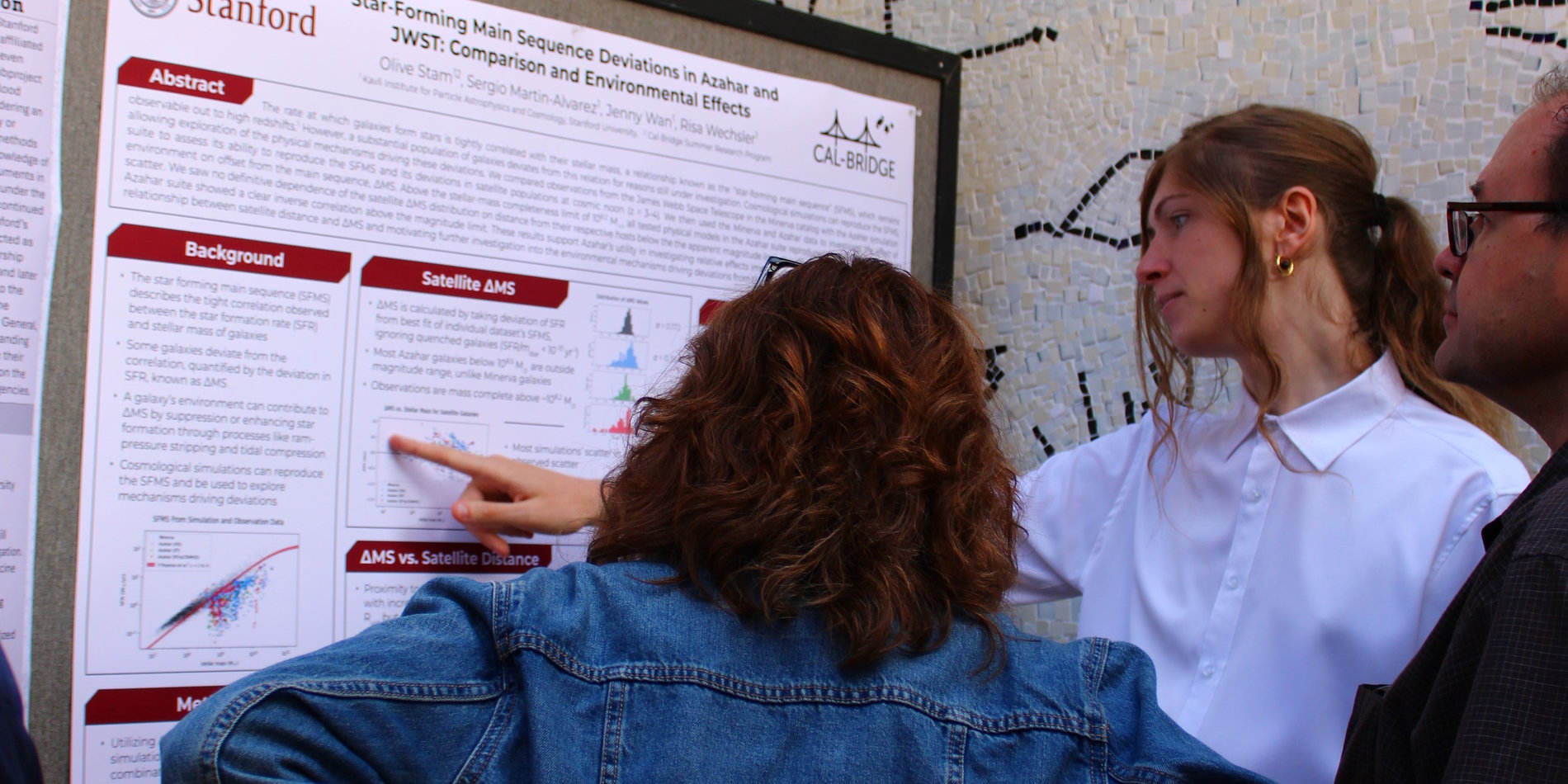
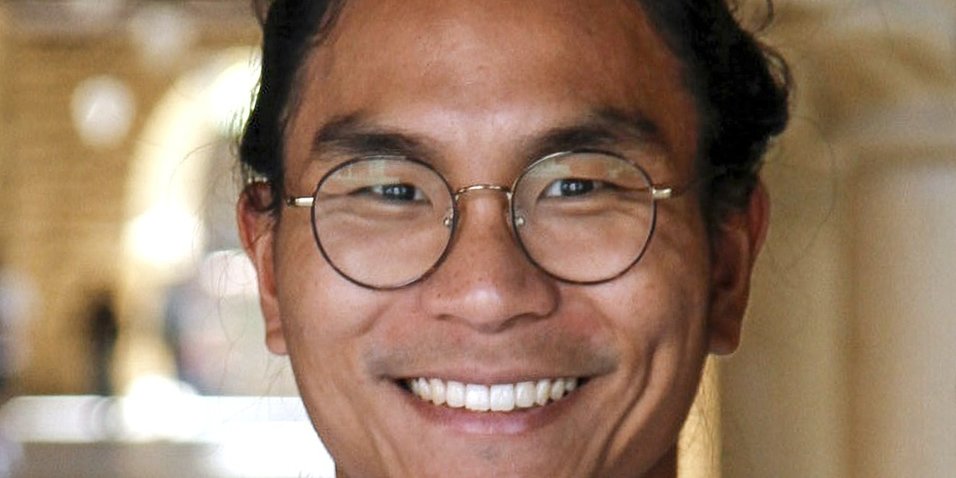
Olive Stam, a student at Cal Poly Pomona working with Risa Wechsler, Sergio Martin-Alvarez, and Jenny Wan, compared real observations from the James Webb Space Telescope to the Azahar suite of cosmological simulations. Her project asked how well those simulations reproduce the way a galaxy's environment — specifically, how close it orbits a larger host galaxy — affects its star formation, a step toward understanding the physical mechanisms driving galaxies away from the well-known relationship between stellar mass and star formation rate (credit: Sanya Gupta, KIPAC).
More Than a Summer of Research
Beyond their individual projects, the cohort spent the summer building a community of peers. KIPAC's Cal-Bridge scholars joined students from a CUNY summer research program for shared professional development sessions throughout the internship, and in early August the whole group gathered for a stargazing night — a fitting break for a cohort of students spending their days studying galaxies, quasars, and neutrinos.
The poster session marks the end of this year's program, but for KIPAC, it's one chapter in a much longer commitment: ten years of opening doors to research careers in physics and astrophysics for students on the Cal-Bridge pathway, many of whom transferred from California community colleges into four-year universities.