
LUX-ZEPLIN
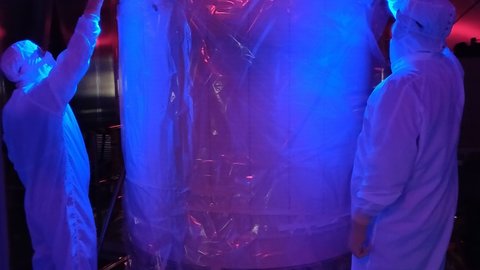
LUX-ZEPLIN (LZ) is currently the world's most sensitive dark matter detector, searching for weakly interacting massive particles (WIMPs) — one of the leading candidates for the invisible matter that makes up 85% of the mass in the universe. Installed nearly a mile underground at the Sanford Underground Research Facility (SURF) in South Dakota, LZ has been operating since late 2021 and in August 2024 announced world-leading constraints on WIMP interactions, with sensitivity nearly five times better than previous experiments. The collaboration continues collecting data toward a target of 1,000 live days through 2028.
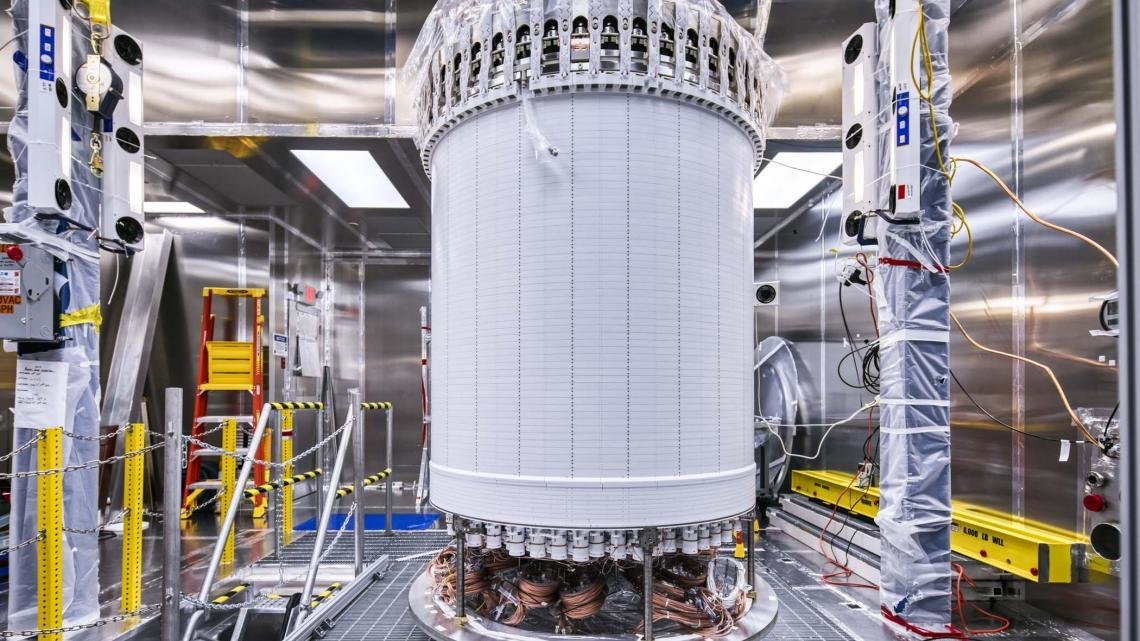
LZ uses 10 tonnes of ultrapure liquid xenon in a two-phase time projection chamber. When a particle interacts with a xenon nucleus, it produces a flash of scintillation light and frees electrons that drift upward through an electric field, generating a second light signal. This dual-signal technique allows LZ to reconstruct the position, energy, and type of each interaction—essential for distinguishing a rare dark matter event from background noise.
LZ is a collaboration of approximately 250 scientists from 38 institutions worldwide, managed by Lawrence Berkeley National Laboratory. KIPAC plays a central role, from detector design and fabrication through operations and data analysis. The SLAC LZ group developed and operates the xenon purification system that removes radioactive krypton contamination to below one-tenth of a part per trillion—a critical requirement for detecting faint signals above background. SLAC also built and tested the detector's high-voltage electrode grids, operated a prototype test platform to validate the detector design, and leads key aspects of operations and analysis including key AI/ML innovations in anomaly detection.
The search for WIMPs
Dark matter reveals itself through gravitational effects on galaxies and the large-scale structure of the universe, yet decades of searches have not identified its particle nature. WIMPs are theoretically motivated candidates that would have been produced in the early universe and could interact with ordinary matter through the weak nuclear force — rarely enough to have escaped detection so far, but often enough to be within reach of sufficiently sensitive experiments.
LZ's underground location shields it from cosmic rays, while careful material selection and the xenon's self-shielding properties minimize backgrounds from natural radioactivity. A "salting" procedure — injecting artificial signals during data collection — ensures analysts remain blind to the true data until final analysis, preventing unconscious bias. LZ probes WIMP-nucleon cross sections down to approximately 2×10⁻⁴⁸ cm² for a 40 GeV WIMP mass, exploring parameter space predicted by supersymmetry and other extensions of the Standard Model.
Beyond WIMPs
LZ's sensitivity extends beyond the traditional WIMP search to include low-mass dark matter, axion-like particles, and other exotic candidates. The detector also enables studies of rare physics processes including neutrinoless double beta decay and solar neutrinos. In December 2025, LZ reported the strongest evidence to date for boron-8 solar neutrinos interacting with xenon through coherent elastic neutrino-nucleus scattering (CEvNS) — a preview of the "neutrino fog" that represents both a background and a physics opportunity for future dark matter searches.
For more information about LZ and KIPAC's role in the experiment, see SLAC's Lux-Zeplin page.
Related Research Areas

Physics of the Universe
At KIPAC, we are working to understand the physics that shapes the origins, evolution and fate of the Universe.Related Research Topics
Related People
-

Daniel Akerib
Professor of Particle Physics and Astrophysics -

Tomasz Biesiadzinski
FPD Associate Scientist -
Zhixuan Li
Ph.D. Student -
Steffen Luitz
Info Sys Spec -

Eli Mizrachi
Postdoctoral Scholar -

Liam Sherman
Ph.D. Student -

Thomas Shutt
Professor of Particle Physics and Astrophysics -
Ann Wang
Panofsky Fellow


