Dark Matter Detection at the Edge of Perception

Axions as the dark matter
Galaxies and their clusters behave heavier than they appear. Their gravitational motion suggests that there must be some sort of non-luminous (“dark”) matter to explain the discrepancy between their observed and expected motion. The axion fulfills all of the requirements to qualify as a dark matter candidate, while also explaining a longstanding problem in nuclear and particle physics, relating to the binding forces within nuclei. The particular model of axion that could solve this problem is called the “Quantum Chromodynamics” or “QCD” axion.
Calling the axion a ‘particle’ is a bit of a misnomer. Much lighter than any other form of matter, it behaves much more like a wave than a particle. In fact, the existence of the axion would imply a modification to Maxwell’s equations, which govern the theory of electromagnetic waves and underlie nearly every facet of modern technology, from our cell phones, to the internet and more.
The implication of this modification is that the axion can convert into a light particle, or photon, in the presence of a magnetic field via a type of interaction known as the ‘Inverse Primakoff Effect’. The axion we look for today was long thought to be ‘invisible’ because of the statistical improbability of its conversion to a photon. Pierre Sikivie, however, first devised a means of detecting the axion using a ‘haloscope’, dubbed as such in reference to the larger dark matter ‘halo’ in which our galaxy sits.
The Sikivie haloscope aims to directly detect the ambient dark matter here on Earth using a cavity resonator immersed in a strong magnetic field. Just as the length of a string instrument sets its pitch, the dimensions of the cavity determine its resonance frequency. When the mass of the axion is proportional to this natural frequency, the axion ‘rings up’ the cavity, generating an electromagnetic signal that can be measured by an antenna inserted into the top of the cavity.
To be sensitive to the QCD axion, it is necessary to detect a signal close to about 10-23 Watts. A detector capable of measuring this signal would have to achieve the equivalent sensitivity of a cell phone that received “four bars” of reception on Mars. Sensitivity to such small signal powers required significant advancements in the field of quantum sensing.
Quantum sensors to the rescue
Sensitivity to the QCD axion was first achieved through the use of a quantum sensor called a ‘microstrip SQUID amplifier’ or MSA. Superconducting Quantum Interference Devices (SQUIDs) are a key piece of quantum circuits. The MSA used in the experiment was fabricated at UC Berkeley by the recent Nobel Prize winner, John Clarke, [1], who won his Nobel for work closely related to this amplifier. Since that time, the landscape of quantum sensing has evolved dramatically, and hardware originally used for axion searches has been pivotal for constructing quantum computers. Both Stanford and SLAC are deeply involved in the technological development of many such sensors. Radiofrequency Quantum Upconverters (RQUs) and Single Microwave Photon Detectors (SMPDs) are two varieties of sensors that researchers hope to deploy in axion searches.
Axions at Stanford and SLAC
There are two major axion haloscope efforts at KIPAC that use resonators to search for dark matter. The DMRadio experiment searches for ‘low’ frequency axion signals (< 200 MHz), and the Axion Dark Matter eXperiment (ADMX), searches for ‘high’ frequency axion signals (>200 MHz).
The DMRadio experiment is currently being commissioned at Stanford University. DMRadio uses a ‘lumped element’ circuit consisting of a discrete inductor and capacitor, similar to a traditional radio. The frequency range for DMRadio is best suited to use the aforementioned SQUID in its readout. The experiment will also serve as a long-term testbed for the novel quantum sensors, with RQUs being one of them.
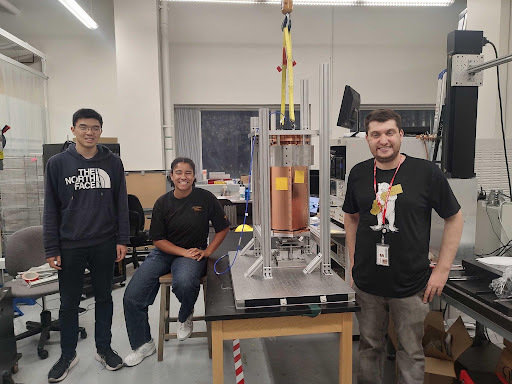
While the ADMX collaboration operates their main search at the University of Washington, SLAC and Stanford are heavily involved in research efforts towards novel cavity resonators. The goal is to maintain sensitivity at higher frequencies through the use of high volume cavities.
Probing the potential axion expanse
Axion dark matter has historically served as a driver for quantum sensors. While quantum-limited sensitivity was essential for probing the QCD axion, the goals for future sensors are broader in scope. Now, researchers are developing sensors that operate below the standard quantum limit over an extraordinary range of frequencies. Advanced superconducting circuits are fabricated in the detector microfabrication facility (DMF) to be tested and deployed in experiments like these. The DMF is a large-scale facility at SLAC that will have the ability to mass produce and refine the fabrication of quantum circuits. As our quantum sensing capabilities continue to expand, so too does our potential for dark matter detection.
References
[1] https://www.nobelprize.org/prizes/physics/2025/press-release/
[2] Chou, Aaron, et al. "Quantum sensors for high energy physics." arXiv preprint arXiv:2311.01930 (2023).
Related Research Areas

Physics of the Universe
At KIPAC, we are working to understand the physics that shapes the origins, evolution and fate of the Universe.Related People

Chelsea L Bartram
Panofsky Fellowship 2022
Andrew K Yi
Res Assoc - Axion Dark Matter