Main content start
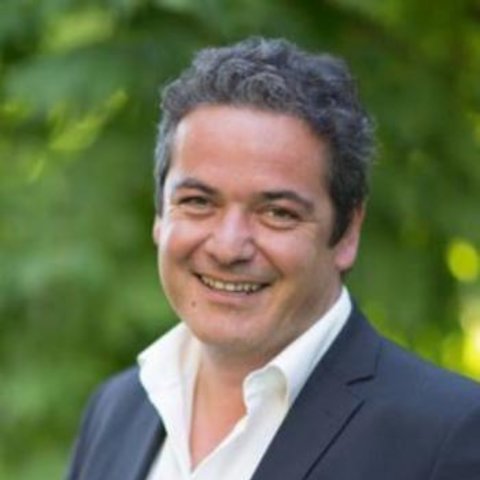
Tom Abel
Professor of Particle Physics and Astrophysics and of Physics
What were the first objects that formed in the Universe, what is it made of, how does it work? Prof. Abel's group explores all of cosmic history using ab initio supercomputer calculations. He has shown from first principles that the very first luminous objects are very massive stars and has developed novel numerical algorithms using adaptive-mesh-refinement simulations that capture over 14 orders of magnitude in length and time scales. He has shown how the first stars galaxies form and affect everything that follows later. He has been pioneering novel numerical algorithms to study collisionless fluids such as dark matter as well as astrophysical and terrestrial plasmas. He has designed bespoke summary statistics to have interpretable, robust, efficient, summary statistics to describe spatial clustering based on fast nearest neighbor searches. His recent work is on creating digital twins of astronomical objects and the Universe as a whole in the context of the Center for Decoding the Universe. This Center leverages advances in machine learning and artificial intelligence to make sense of our Universe. He was the director of the Kavli Institute for Particle Astrophysics and Cosmology and Division Director at SLAC 2013-2018.
Education
Masters, University of Regensburg (1998)
Ph.D, Ludwig Maximillians University Munich (1999)