
Super Cryogenic Dark Matter Search
Observations of galaxies, galaxy clusters, distant supernovae, and cosmic microwave background radiation tell us that about 85% of the matter in the universe is made up of one or more species of dark matter. With the continuing success of the Standard Model of particle physics, the existence of dark matter provides one of the few tangible sign posts as we seek to understand what lies beyond the Standard Model. Deciphering the nature of this dark matter would be of fundamental importance to cosmology, astrophysics, and high-energy particle physics.
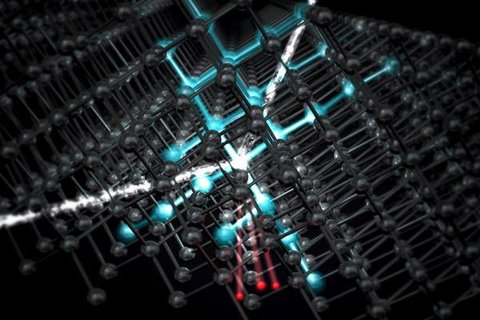
A leading hypothesis is that dark matter consists of particles produced moments after the Big Bang. SuperCDMS is one of several experiments underway to directly detect these particles and begin an era of dark matter science that we hope will enable us to understand the nature of dark matter.
The SuperCDMS Experiment
The SuperCDMS experiment is designed to detect dark matter particles with masses in the range of about 0.5 GeV/c2 to 10 GeV/c2, equivalent to the mass of about 0.5 to 10 protons. The SuperCDMS SNOLAB experiment is installed two kilometers underground in Canada's SNOLAB underground research facility in Sudbury, Ontario. SuperCDMS SNOLAB follows on from previous versions of the experiment located underground at Stanford University and then underground at the Soudan Mine, a former iron mine in Minnesota.
SuperCDMS uses approximately one kilogram crystals of silicon and germanium that are cooled to a small fraction of a Kelvin above absolute zero. These ultra-cold crystals are designed to detect dark matter particles colliding with silicon and germanium nucleons, and measure the collision energy deposited into phonons in the crystals. The experiment at SNOLAB has a total of 24 detector crystals—18 germanium and six silicon—arranged in four towers, with each tower housing a stack of six detector crystals.
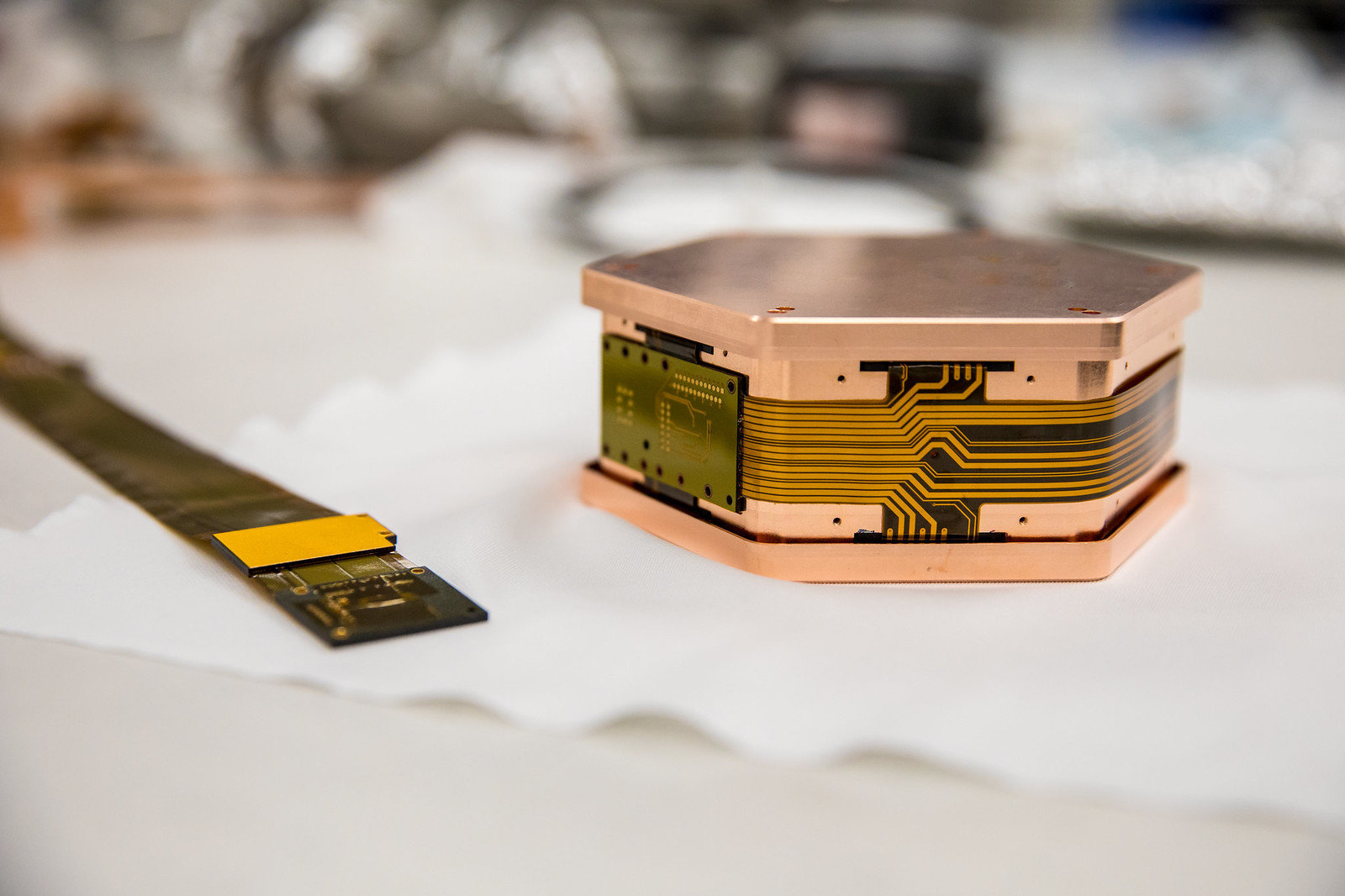
Two types of detector operations and readouts are used to help discriminate between nuclear recoils from dark matter particle interactions and electron recoils. The energy deposited in a detector by an interacting dark matter particle may be as low as a few tens of electron volts (eV). The SuperCDMS SNOLAB experiment began a three-year period of science data collection in 2026, following construction of the experiment between 2020–2026, followed by a one-year commissioning period.
The SuperCDMS Collaboration
The SuperCDMS SNOLAB experiment was built by the member institutions of the SuperCDMS Collaboration, in a project funded by the Department of Energy (DOE) and the National Science Foundation (NSF) in the U.S., and by the Canada Foundation for Innovation (CFI) in Canada. SLAC National Accelerator Laboratory (SLAC) hosted the the management of the project and other major collaborators include Fermi National Accelerator Laboratory (Fermilab), Pacific Northwest National Laboratory (PNNL), SNOLAB, and a consortium of U.S., Canadian, and other international universities. Stanford and SLAC scientists and engineers were responsible for detector fabrication, and the design, assembly, and cold-testing of the detector towers, managed by KIPAC senior staff scientist Richard Partridge.
The SuperCDMS Collaboration consists of about 200 members from 26 institutions, of which 16 institutions are in the U.S., six are in Canada, and one each can be found in the UK, France, Germany, and India. Of the US institutions, three are DOE national laboratories (Fermilab, PNNL and SLAC), while seven university groups have research support from DOE (Caltech, Florida, Minnesota, South Dakota Mines, South Dakota, Stanford, and Texas A&M), and five university groups have research support from NSF (Berkeley, U. Colorado Denver, Florida, Northwestern, and Santa Clara). The six Canadian institutions are British Columbia, Montreal, Queen’s, SNOLAB, Toronto, and TRIUMF.
SuperCDMS Operations
Operations of the SuperCDMS SNOLAB experiment is managed at SLAC. The Operations Manager is SLAC research technical manager and KIPAC associate member Dr. Tina Cartaro, with Deputy Operations Managers supported by NSF and Canada.
The operations team assisted with installing and integrating the experiment at SNOLAB, and then led the commissioning of the experiment to bring it to a science-ready level of performance. Following three years of science data-taking, the operations team will then be responsible for the decommissioning and disposition of the experiment. SuperCDMS operations scope also included testing of detectors at the Cryogenic Underground TEst (CUTE) facility located underground at SNOLAB, and calibration and response measurement of detectors at the Northwestern EXperimental Underground Site (NEXUS) facility at Fermilab. SuperCDMS Operations makes use of the computing facility at SLAC, with SuperCDMS data being processed, archived and managed at SLAC, and with secondary data storage at Fermilab.
For more information, see SLAC's SuperCDMS webpage.
Related Research Areas

Physics of the Universe
At KIPAC, we are working to understand the physics that shapes the origins, evolution and fate of the Universe.Related Research Topics
Related People
-

Blas Cabrera
Stanley G. Wojcicki Professor, Emeritus -

Robert Cameron
Emeritus Staff -

Hope Fu
Ph.D. Student -

Noah Kurinsky
Senior Scientist -

David MacFarlane
Professor of Particle Physics and Astrophysics, Emeritus -
Richard Partridge
Senior Scientist -

Kelly Stifter
Panofsky Fellowship 2023


