KIPAC Researchers Help Power the Simons Observatory’s Full Launch

A new survey of the sky, from the largest structures in the universe to the dust and magnetic fields in our own Milky Way, is now fully underway. After two years of calibration, additional telescopes and a new solar array to provide energy security, the Simons Observatory in Chile’s Atacama Desert is fully online and conducting science operations. Researchers at the Kavli Institute for Particle Astrophysics and Cosmology (KIPAC) at Stanford and SLAC National Accelerator Laboratory have had a hand in nearly every part of it.
The observatory’s four telescopes sit at 17,000 feet (5,200 meters), where they map the cosmic microwave background (CMB), the oldest light in the universe, and the millimeter-wave sky in front of it. That data will help reveal what interstellar dust is made of, how magnetic fields shape star-forming regions, and where stellar explosions and other transient events are occurring. It will also trace how galaxies and dark matter are arranged across the universe, the large-scale structure that holds clues to dark energy. Early data are already competitive with the best CMB maps, including those from the European Space Agency’s Planck satellite.
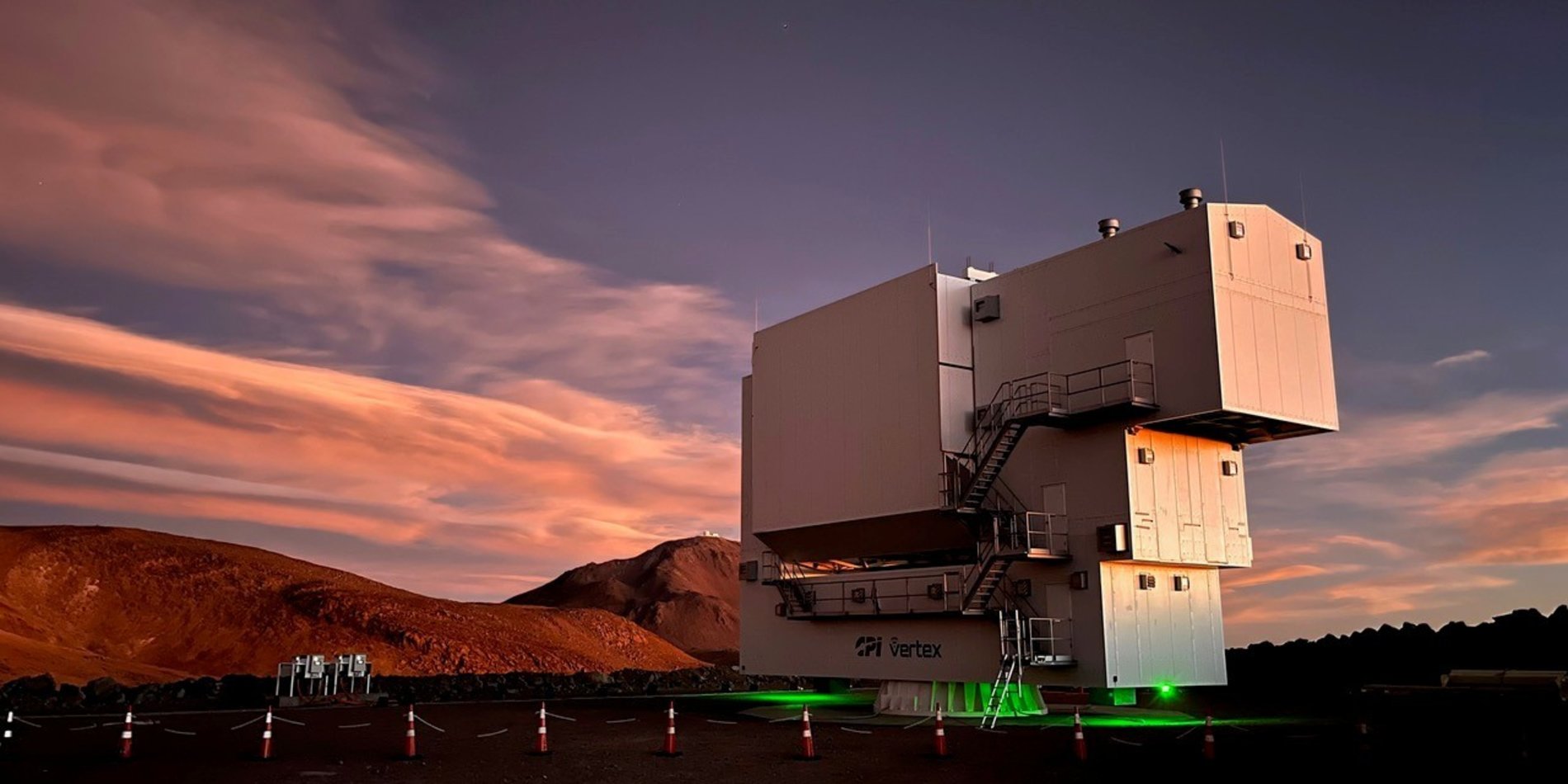
Photo taken by Toby Satterthwaite of the 6 m large-aperture telescope at sunset. At this point, the mirrors were not yet installed so they hadn't achieved first light.
Building the camera
At the center of KIPAC’s contribution is the receiver, or camera, of the observatory’s 6-meter Large Aperture Telescope (LAT). It now holds 63,000 superconducting sensors, making it the largest cryogenic camera for cosmology to date. The team deployed the first 31,000 detectors in February 2024 and the final 32,000 earlier this year.
The SMuRF readout electronics that make the detectors work were developed by the KIPAC and SLAC group led by Zeesh Ahmed, Associate Professor of Particle Physics and Astrophysics. The group worked with SLAC engineers Gunther Haller, Ryan Herbst, and Larry Ruckman of the Technology Innovation Directorate to design and build them. Postdocs, students, and staff scientists, including Shawn Henderson, Tristan Pinsonneault-Marotte, Carlos Sierra, and Toby Satterthwaite, spent months at the site assembling and deploying the receiver. Satterthwaite, a physics Ph.D. student, has just published a paper on the instrumentation work for the LAT.
“Our group at SLAC developed the electronics that read out every one of those sensors, so seeing that hardware perform at this scale is the payoff of years of work by students, postdocs, and staff,” Ahmed said.
Satterthwaite has traveled to the site seven times between 2023 and 2026, starting when the telescope was still an open frame with a wooden board over its aperture. “Seeing the telescope collect its first light, alongside many of my colleagues, has been a real highlight of my PhD,” he said.
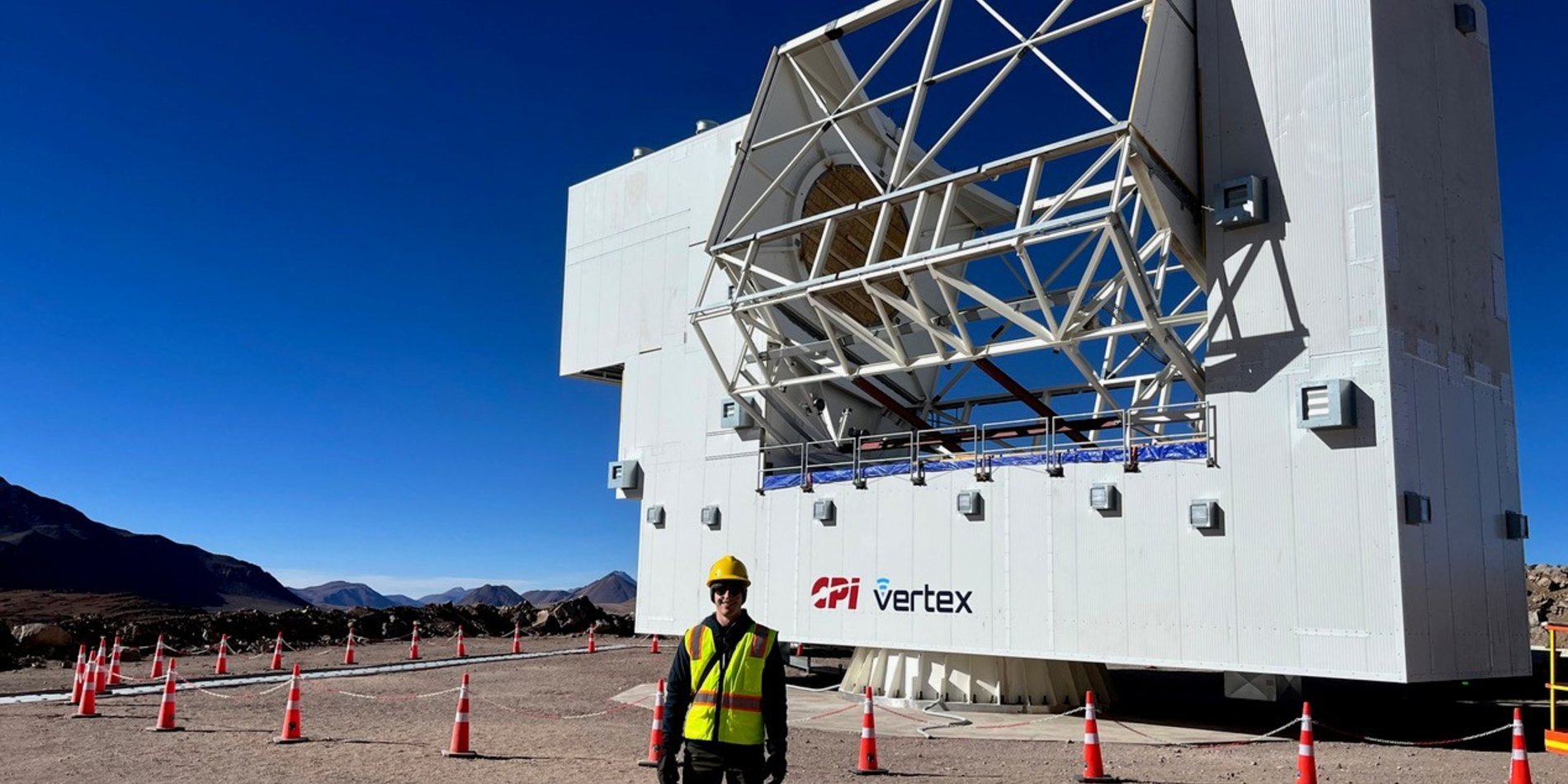
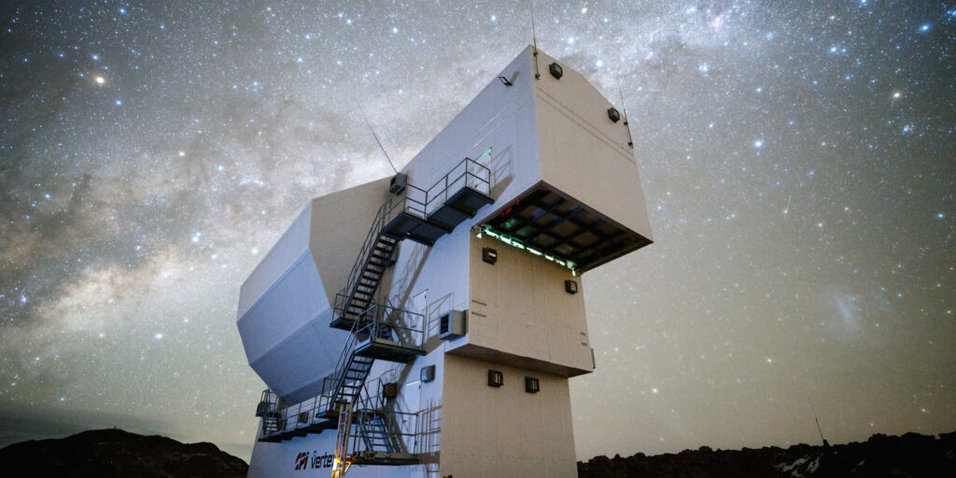
Toby Satterthwaite with the large-aperture telescope in September 2023, when it was still under construction (so its mirror enclosure was still an exposed frame, the mirrors were not yet installed, and there’s a wood board covering the telescope’s aperture).
Mapping the Milky Way
The LAT has already produced the most comprehensive images of the Milky Way in polarized microwave light. In addition to cosmological signals, the LAT is mapping the polarized microwave light from our own Milky Way galaxy. These maps reveal the structure of the Galaxy’s magnetic fields, which matter for understanding star formation and galactic evolution. Susan Clark, Assistant Professor of Physics, co-led two forecasting papers (2022 and 2025 of which had over 150 citations) that shaped the observatory’s Galactic science plans. Her graduate student Kaitlyn Karpovich is one of the key people mapping and analyzing the polarized emission from the Galactic center, which appears in the observatory’s first images.
“Polarized light at these wavelengths helps reveal the invisible magnetic fields in the space between the stars,” Clark said. “The Simons Observatory gives us a new view of the Milky Way, and we’re thrilled to start using these data to learn new things about our interstellar environment.”
Weighing the universe’s structure
KIPAC scientists are also preparing to use the observatory’s data to study how matter is distributed across the cosmos. Emmanuel Schaan, Assistant Professor of Particle Physics and Astrophysics, helped develop the initial science case for the observatory, including the need for high resolution to measure secondary CMB signals and to cross-correlate with the Vera C. Rubin Observatory’s LSST (2019 paper of which had more than 1500 citations).
“When we first laid out the science case for the Simons Observatory, we argued that high resolution would let us study the cosmic web and cross-correlate with surveys like LSST,” Schaan said. “Now the telescopes are running, and we’re ready to put that vision to work, including with the kSZ effect.”
Schaan’s group focuses on the kinematic Sunyaev-Zel’dovich (kSZ) effect, a tiny shift in CMB light as it scatters off moving gas. Former graduate student Bernardita Ried Guachalla, now a postdoctoral researcher at the University of Cambridge, and NASA Hubble Fellow Frank Qu pushed the state of the art in kSZ measurements using the Atacama Cosmology Telescope (ACT), the observatory’s predecessor, in preparation for Simons Observatory data (Qu et al.; Ried Guachalla et al.). “The work we did with ACT was always about preparing for this,” Ried Guachalla said. “It’s wonderful to see the Simons Observatory up and running.”
Qu also plays a leading role in analyzing CMB lensing, the subtle bending of CMB light by intervening matter. He developed the lensing pipeline now used for the observatory’s analysis and validated it on the latest ACT lensing measurements, the direct testbed for the new data (paper 1; paper 2).
We spent years building and stress-testing our lensing analysis on ACT so we’d be ready for this moment,” said Qu, who leads CMB lensing for SO. “Now, within SO’s first observations, we’re already seeing the faint distortions that all the matter in the universe imprints on the oldest light we have. That’s a remarkable start. These maps will let us map the universe’s dark matter to subpercent precision and test how structure has grown over cosmic time."
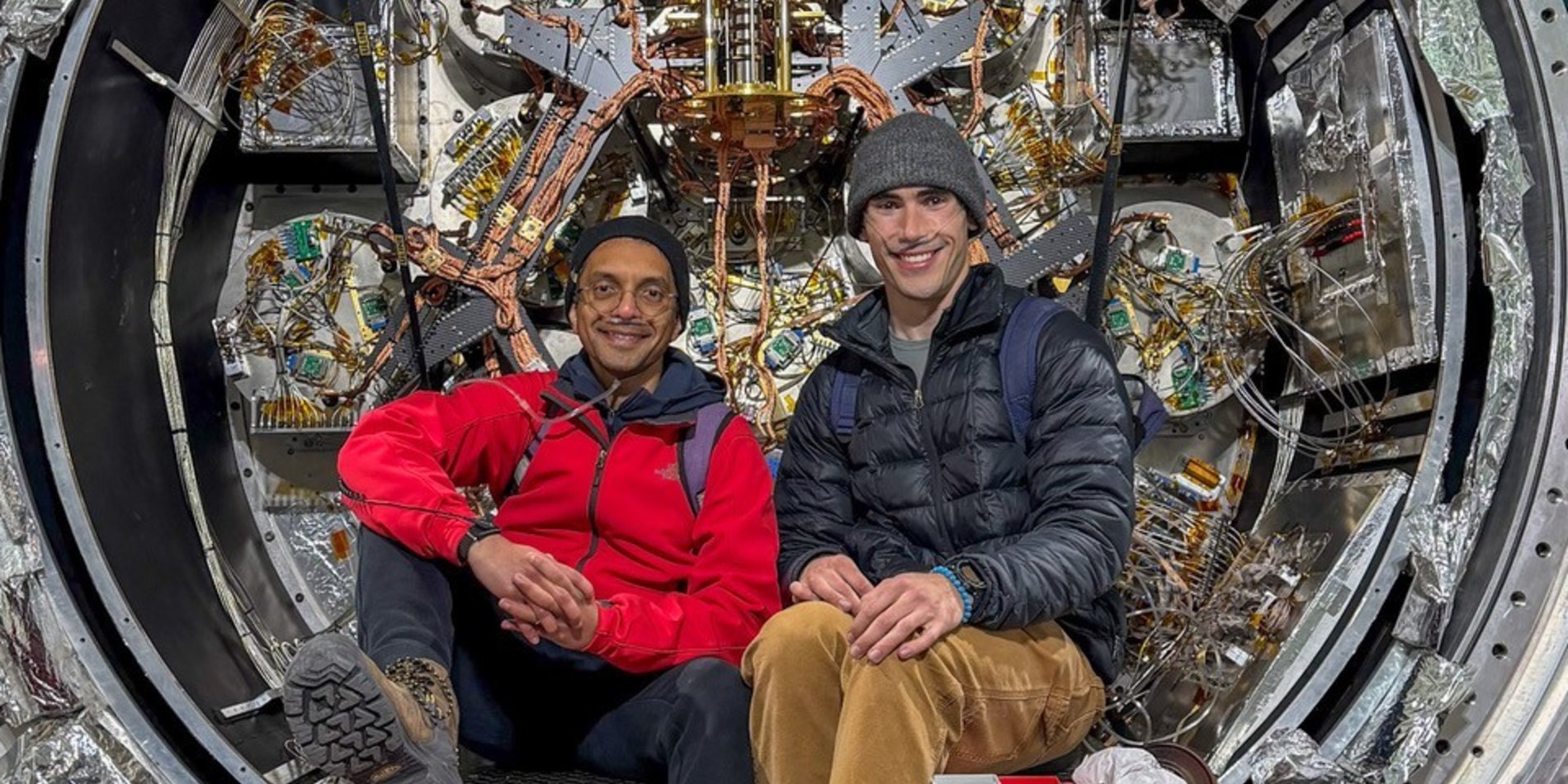
Toby Satterthwaite and Zeesh Ahmed with the open large-aperture telescope receiver, following the deployment of its final 32,000 detectors earlier this year, to make 63,000 total. January 2026.
What’s next
With the upgrade described earlier now complete, the observatory has added three more small-aperture telescopes funded by the UK and Japan, along with new NSF-funded instrumentation that doubles the LAT’s mapping speed. It will regularly release data to the broader astronomy community. Observatory co-director Mark Devlin said, “I think there’s going to be so many scientific discoveries coming out in the next few years, it’ll be hard to keep up.”
For KIPAC, which helped build the instruments and now helps analyze their data, that work is only beginning.
Related People

Zeeshan Ahmed
Associate Professor of Particle Physics and Astrophysics
Susan E. Clark
Assistant Professor of Physics
Kaitlyn Karpovich
Ph.D. Student
Frank J Qu
Postdoctoral Scholar
Toby Satterthwaite
Ph.D. Student