All in the family: Fermi data links supernova siblings
A study led by KIPAC postdoctoral fellow Miltiadis Michailidis has uncovered compelling evidence that two neighboring supernova remnants (SNRs), the debris left behind after stars explode, are actually the remains of massive companion stars that once orbited each other before exploding tens to hundreds of thousands of years apart.
The first star’s detonation sent its binary companion hurtling through space, and then, after traveling for thousands of years, the surviving star blew up too.
The discovery, presented by Michailidis on June 17, 2026, during a meeting of the American Astronomical Society in Pasadena, California, and published today in Nature Communications, is supported by more than 16 years of observations from NASA's Fermi Gamma-ray Space Telescope (Fermi) and its primary instrument, the Large Area Telescope (LAT). It provides the first candidate binary SNR system ever identified.
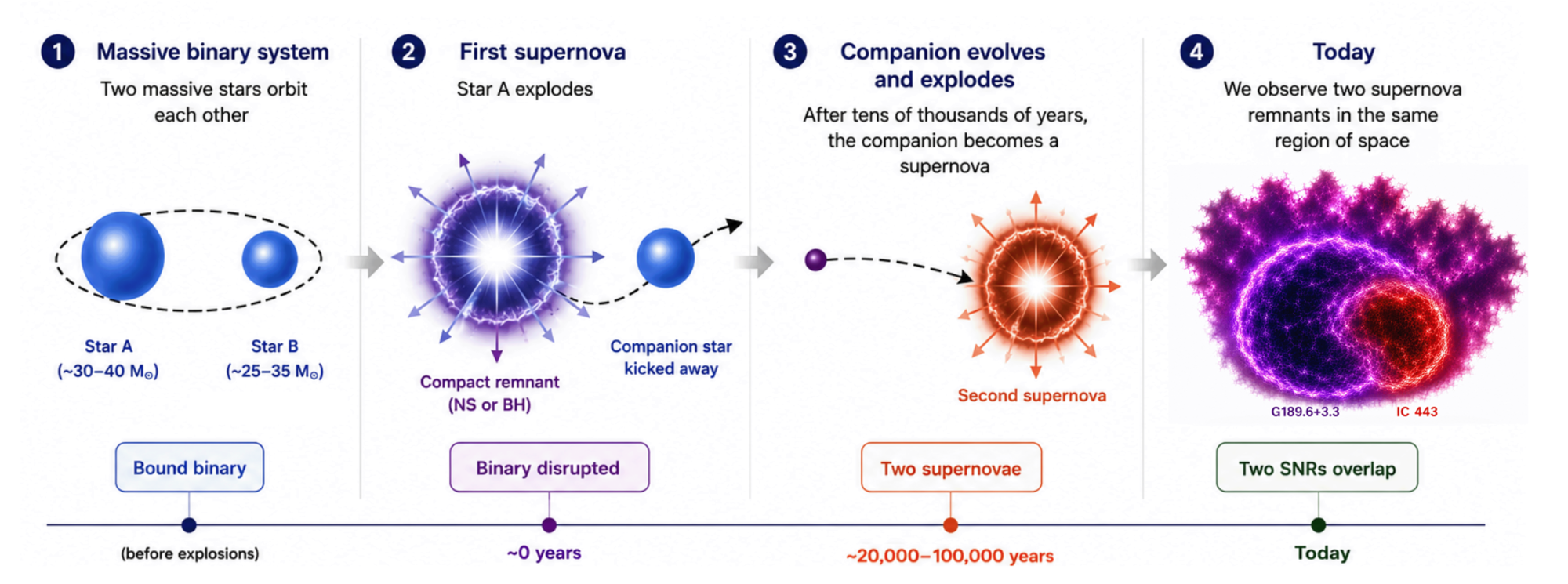
The study focused on two supernova remnants — the well-known and well-studied Jellyfish Nebula (IC 443), and its supposed sibling, a faint remnant called G189.6+3.3.
"The discovery itself is fundamentally based on Fermi," says Michailidis. "The Large Area Telescope was the first instrument to reveal another gamma ray-emitting supernova remnant hidden in the shadow of IC 443 — one of the brightest gamma ray remnants in the sky. Without Fermi's long-term observations, we simply would not have known it was there."
For almost two decades, Fermi continuously accumulated gamma-ray photons from the region, dramatically increasing the statistical power of the observations. The larger data set allowed the team to focus on higher-energy gamma rays — where the LAT's imaging capability is substantially sharper — while also enabling a more reliable separation of nearby sources and diffuse Galactic emission. Together, these advances made it possible to isolate the faint, extended gamma-ray emission from G189.6+3.3 for the first time, revealing that what had long appeared as a single broad glow was actually two distinct SNRs.

But the LAT did more than identify another supernova remnant. It revealed that different regions of G189.6+3.3 are powered by different particle populations. Along the remnant's northern boundary, the gamma rays originate predominantly from high-energy protons interacting with dense gas. Elsewhere, they are produced primarily by high-energy electrons.
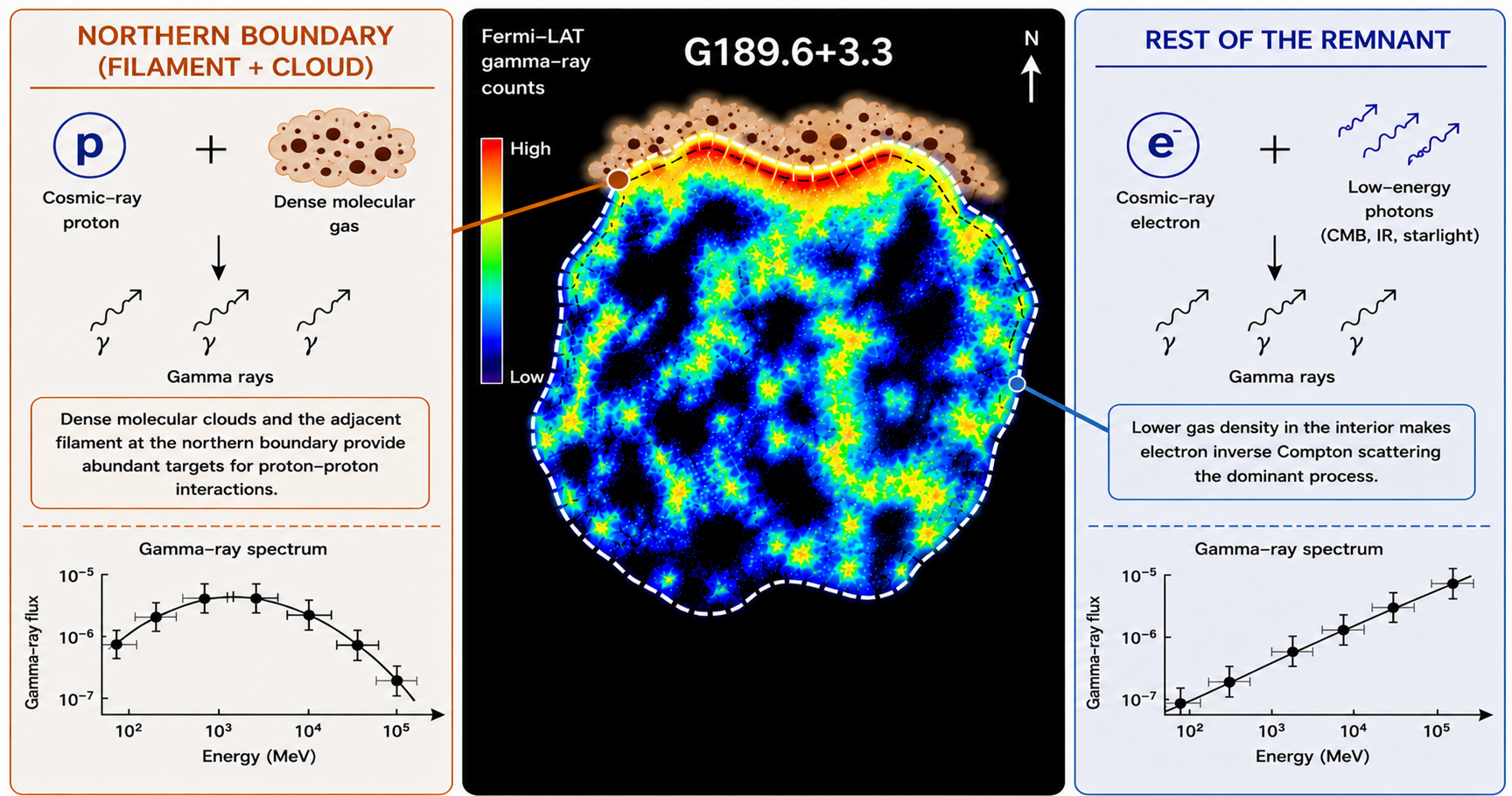
To the team's knowledge, this is the first gamma ray-emitting SNR ever observed with such a clear spatial separation between dominant hadronic (proton-based) and leptonic (electron-based) particle acceleration.
That separation immediately pointed to a physical explanation. The hadronic gamma rays are confined to the northern boundary, precisely where the remnant collides with a dense cloud of gas with which the Jellyfish Nebula was already known to interact. In other words, the two overlapping remnants are the first known pair of overlapping SNRs demonstrated to be physically associated rather than simply aligned by chance.
“The evidence we’ve compiled — including observations across the spectrum, the chemical and physical properties of the remnants, simulations, and more — paints a compelling picture of a dual supernova event,” says Michailidis.
An independent statistical analysis shows that the probability of the observed configuration arising through a chance alignment is only about 0.1%, making a coincidental association highly unlikely.
This discovery opens an entirely new way to study how massive binary stars live and die. While most massive stars are born with stellar companions, the violent explosions that end their lives usually erase the evidence that they were once bound together. Finding the remnants of both explosions preserved in the same system offers a rare opportunity to test theories of binary evolution, supernova explosions, and the environments that shape them.
Beyond revealing the first candidate binary supernova remnant system, the Fermi observations identify one of the best targets yet for future high-energy neutrino searches from this source class. Because the hadronic gamma-ray emission is confined to a well-defined region with minimal contamination from leptonic emission, the northern boundary of G189.6+3.3 provides an exceptionally clean laboratory for testing whether supernova remnants accelerate galactic cosmic rays through hadronic interactions. Detecting neutrinos from this region would provide the long-sought direct evidence linking supernova remnants to the origin of galactic cosmic rays.
But none of these discoveries would have been possible without the remarkable longevity of NASA's Fermi Gamma-ray Space Telescope. In fact, on July 13, 2026, Fermi hit a major milestone — its 100,000th orbit — more than a decade beyond its original design lifetime. The binary-system interpretation rests firmly on more than sixteen years of continuous observations.
"Fermi has long outlived its expected lifetime," says co-author and KIPAC research scientist Niccolò Di Lalla, who joined the LAT Collaboration in 2015. "Yet it continues to perform extraordinarily well. There is simply no other instrument operating in Fermi's energy range, and without its long-term observations we would have missed discoveries like this entirely."
"For more than sixteen years, the Fermi Large Area Telescope has continuously mapped the high-energy sky with a sensitivity no other mission has matched," says co-author and KIPAC senior research scientist Nicola Omodei, who has been with Fermi since the beginning. "It is the mission that truly opened the gamma-ray universe to continuous exploration. Discoveries like this demonstrate the extraordinary scientific legacy of long-term gamma-ray observations and show why Fermi continues to transform our understanding of the high-energy universe."
The LAT was conceived and built at KIPAC’s home institutions, Stanford University and SLAC National Accelerator Laboratory, and KIPAC continues to lead the the LAT’s collaborative research team.
Related Research

Extreme Astrophysics
We at KIPAC have an active Compact Object Group Meeting (COG) which meets Tuesdays to discuss progress in extreme astrophysics.Related People

Miltiadis Michailidis
Postdoctoral Scholar
Niccolo Di Lalla
Physical Science Research Scientist