
Cosmology in Overdrive: Chasing Cosmic Acceleration with Galaxies
Event Details:
Location
This event is open to:
About the Lecture
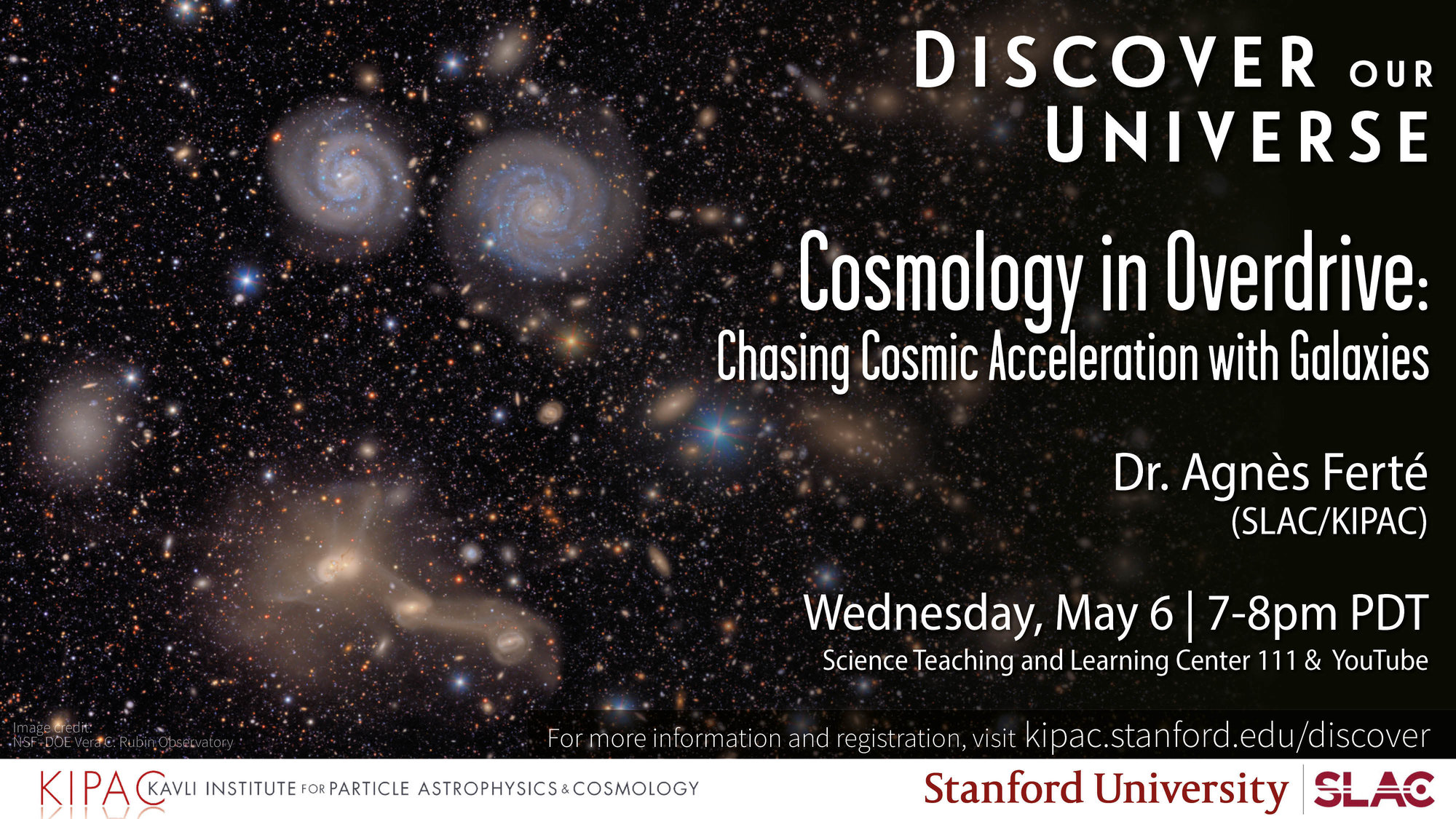
Nearly 30 years after the discovery of cosmic acceleration, its origin remains the source of open questions: is it caused by dark energy, a mysterious energy causing the Universe’s expansion to go faster and faster with time? Or was Einstein’s theory of gravity wrong? Cosmology is now at a turning point: tensions between different measurements are appearing, and a deluge of data from new ambitious experiments will come over the coming decade. In this talk, I will discuss how imaging galaxies is key to addressing these questions and present where cosmology stands today: at the crossroads between the completion of current galaxy surveys, such as the Dark Energy Survey (DES), which imaged hundreds of millions of galaxies, and the next generation of observatories, such as the Vera C. Rubin Observatory, which will image billions. I will also highlight the final cosmological results from DES, particularly those related to the possible time dependence of dark energy, describe the promise of the Rubin Observatory, and discuss how this new era of data—along with the rise of artificial intelligence—will help us characterize the expansion history of the Universe and test gravity on the largest scales with unprecedented precision.
Live stream URL can be found at the bottom of the EventBrite registration confirmation email.
About the Speaker

Agnès Ferté is a research scientist at the SLAC National Accelerator Laboratory, studying dark energy and gravity using large-scale galaxy surveys. After earning her Bachelor’s degree in physics and a PhD in astrophysics from Université Paris-Sud, she began studying the Universe through galaxy surveys (such as the Dark Energy Survey) during her postdoctoral work at the Royal Observatory, Edinburgh, and further advanced this research at the Jet Propulsion Laboratory in Pasadena, CA. More recently, she has been working to ensure the quality of data from the Vera C. Rubin Observatory and to design some of the most precise tests of gravity at cosmic scales. Since reading about the Universe’s expansion in a magazine, Agnès has been driven since her teenage years to be an active participant in the scientific endeavor through collaborative effort. She feels very fortunate that this path has led her to work during one of the most exciting times in cosmology.
Directions and Parking
This event will take place in the Sapp Center for Science Teaching and Learning (376 Lomita Dr.), Room 111. Upon arrival, please follow the directional signs and check in at the foyer.
The closest visitor parking is available on Roth Way, Lomita Dr., in the Roth Way Garage, and along the Stanford Oval. All parking is free in spaces marked Visitor, A, or C after 4pm unless indicated otherwise. Accessible parking is also available in the locations listed above.
If you plan to take public transportation, some lines of the Marguerite Shuttle connect the Palo Alto Transit Center and Caltrain stations to campus. You can get to the Science Teaching & Learning Center by taking Line P (drops off at the Stanford Oval) or Line X (drops off at the Grant Building). A complete list of shuttle schedules and route maps can be found here.
Related Topics
Explore More Events
KIPAC Tea Talk: Model-Independent Measurements of Baryon Feedback with kSZ and Galaxy-Galaxy Lensing
Henry Liu (UC Berkeley)Campus, PAB 102/103-Campus, PAB 102/103Astrophysics Colloquium: Probing the physics of the early universe with pulsating stars
Earl Patrick Bellinger (Yale University)SLAC, FKB 3rd Floor Conf. Rm.-SLAC, FKB 3rd Floor Conf. Rm.