
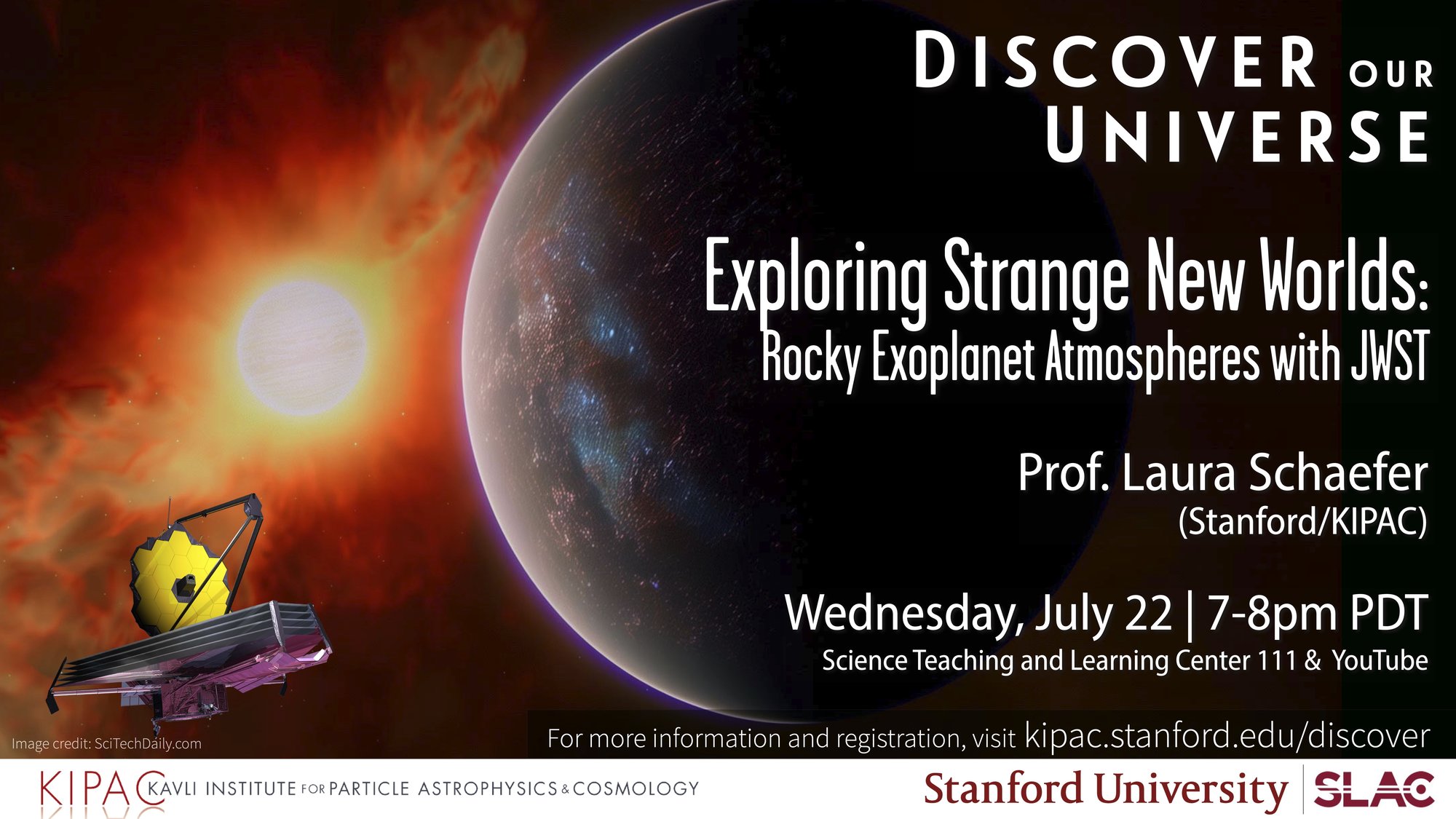
Exploring Strange New Worlds: Rocky Exoplanet Atmospheres with JWST
Event Details:
Location
This event is open to:
About the Lecture
Can we learn about the history and geology of a rocky planet like Earth by measuring its atmosphere? In just a few decades, astronomers have gone from wondering whether planets exist around other stars to discovering thousands of them. Now the James Webb Space Telescope (JWST) is taking the next step: not just finding these worlds, but beginning to study what they’re like—including whether they have atmospheres at all, which are critical for planetary habitability. In this talk, we’ll meet the small, rocky exoplanets that are most like the inner planets of our own Solar System, and see how JWST looks for the faint chemical fingerprints of gases around distant worlds. We’ll also tour what JWST has discovered so far, what has surprised us, and why some planets seem to lose their atmospheres while others manage to hold on. Along the way, we’ll connect these observations to bigger questions about how planets evolve—and what it might take for a world to be truly Earth-like.
Live stream URL can be found at the bottom of the EventBrite registration confirmation email.
About the Speaker

Laura Schaefer is an Assistant Professor in the Department of Earth and Planetary Sciences at Stanford University. She is a planetary scientist working on the theory of how the atmospheres of rocky planets form and evolve due to how they are shaped by processes such as geology and radiation from their host stars. This includes studying processes like plate tectonics, outgassing, asteroid impacts, planet formation and atmospheric escape in order to understand how the habitability of a planet changes over its lifetime. Laura applies her work to both the early Solar System and current observations of exoplanets orbiting other stars. As a lifelong science-fiction fan and a rock climber, Laura loves that her work blends two interests – geology and astronomy – to study other worlds.
Directions and Parking
This event will take place in the Sapp Center for Science Teaching and Learning (376 Lomita Dr.), Room 111. Upon arrival, please follow the directional signs and check in at the foyer.
The closest visitor parking is available on Roth Way, Lomita Dr., in the Roth Way Garage, and along the Stanford Oval. All parking is free in spaces marked Visitor, A, or C after 4pm unless indicated otherwise. Accessible parking is also available in the locations listed above.
If you plan to take public transportation, some lines of the Marguerite Shuttle connect the Palo Alto Transit Center and Caltrain stations to campus. You can get to the Science Teaching & Learning Center by taking Line P (drops off at the Stanford Oval) or Line X (drops off at the Grant Building). A complete list of shuttle schedules and route maps can be found here.
Related Topics
Explore More Events
Astrophysics Colloquium: Our Galaxy’s Dynamic Center
Cara Battersby (University of Connecticut)Campus, PAB 102/103-Campus, PAB 102/103KIPAC Tea Talk: A Resolved View of the ISM and Star Formation in Nearby Galaxy / Primordial Magnetic fields and modified recombination histories
Mansi Padave (UC San Diego), Jonathan Schiff (UCSB)SLAC, Kavli 3rd Floor Conf. Rm.-SLAC, Kavli 3rd Floor Conf. Rm.