Simons Observatory
Located in Chile’s Atacama Desert, the Simons Observatory (SO) is a next-generation observatory that is now online and collecting data in its search for signs of cosmic inflation and answers to fundamental questions about the origin of the Universe. Scientific topics SO is helping to address include:
Primordial Universe

Affected by gravity and amplified by inflation, primordial fluctuations in the density of matter and energy have led to the growth of the large-scale structures we see in the Universe today. SO is measuring CMB fluctuations with unprecedented precision, and these data will allow us to distinguish between many different models of inflation, test the standard model of cosmology, and possibly discover new, exotic particles.
Neutrino Physics
Neutrinos are among the most elusive particles: We do not know how massive they are, and the current model of particle physics cannot explain how their mass is created. SO will provide a robust measurement of neutrino masses through gravitational lensing, the counting of galaxy clusters, and the energy change in CMB photons as they pass through galaxy clusters.
Dark Energy and the Cosmological Constant
Dark energy, which is responsible for the observed accelerated expansion of the Universe, makes up about 70% of the Universe. The simplest way to describe dark energy is the cosmological constant. SO will provide very precise measurements of the current expansion rate, the Hubble constant (H0), that will help confirm or resolve the discrepancies in H0 measured by different probes. If the discrepancy is confirmed, we will need to revise our standard model of cosmology.
Reionization and Galaxy Evolution
"Cosmic reionization” refers to the time when energetic photons emitted by the first stars and galaxies ionized the ordinary matter (mostly hydrogen) in the Universe. By studying patterns imprinted on the CMB by free (ionized) electrons, SO will deepen our understanding of reionization, constraining its onset and duration. SO will also provide key insights into galaxy formation by measuring the energy gain of CMB photons as they pass through giant clusters of galaxies filled with hot gas.
Galactic Science
In addition to observing distant galaxies and the CMB, SO will measure emission from the interstellar medium of our own Galaxy. This provides us with a unique opportunity to obtain more information on the dust, gas, and magnetic fields in the Milky Way. SO is also measuring emission from the interstellar medium of our own Galaxy, and will be able to map magnetic fields in various interstellar environments, shedding light on the physical mechanisms behind Galactic emission, such as the role magnetic fields play in driving star formation from cold, dense clouds, the composition of interstellar dust, and the population of energetic cosmic-ray electrons.
Now that construction is completed, SO consists of the following telescopes:
- A large-aperture telescope (LAT) that has a 6-meter diameter aperture to explore the CMB at small angular scales
- Three small-aperture telescopes (SATs), each with seven 6” detector wafers, to study the CMB at large angular scales
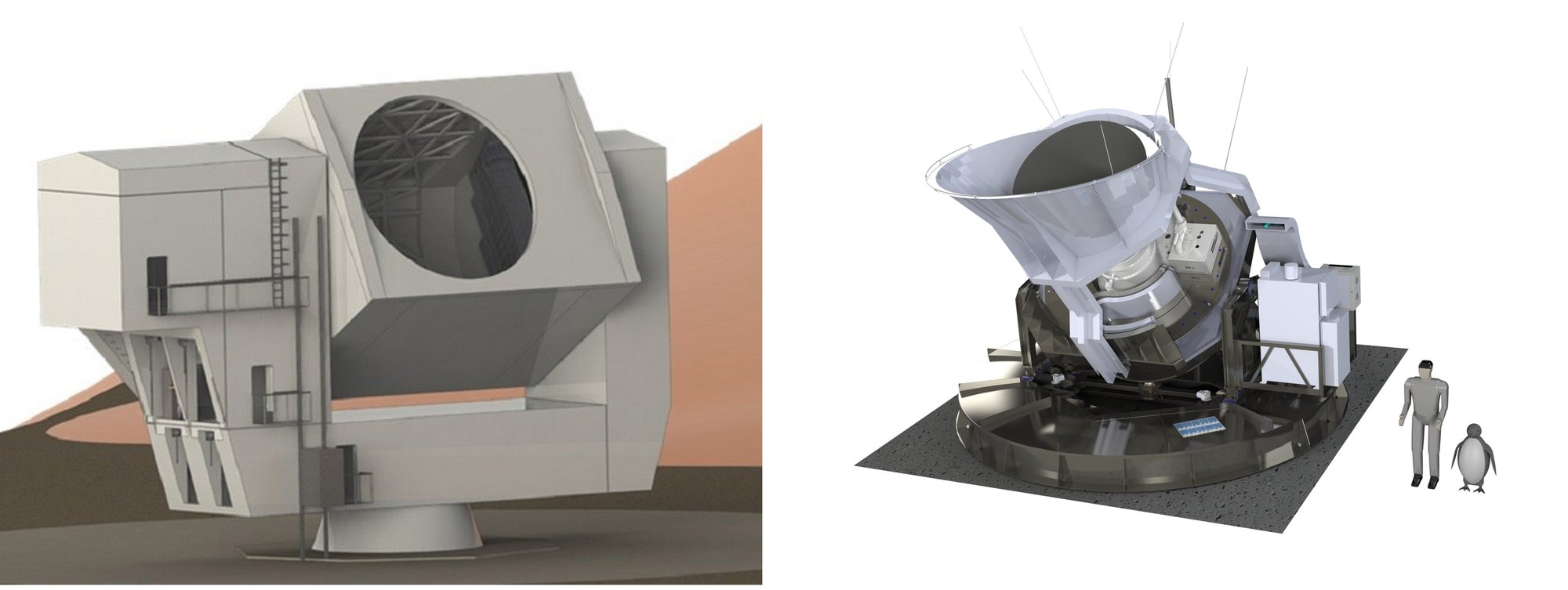
SO is a collaboration between the Simons Foundation, the founding universities and laboratories (University of Pennsylvania, Princeton University, UC San Diego, UC Berkeley, and the Lawrence Berkeley National Laboratory) and collaborating institutions across the globe. KIPAC researchers will be actively using the SO data to explore frontier questions about the early Universe through the studies of CMB, galaxy clusters, and dark matter. For more information on SO, please visit the Simons Observatory website.
Related Research Areas

Cosmic Ecosystems
Cosmologists at KIPAC study the structure of the Universe from nearby galaxies and their satellites to the distribution of galaxies on the largest scales across the Universe.
Physics of the Universe
At KIPAC, we are working to understand the physics that shapes the origins, evolution and fate of the Universe.
Solar, Stellar, and Planetary Astrophysics
At KIPAC, we study the processes that govern the formation of stars and their planetary systems.Related People
-

Zeeshan Ahmed
Associate Professor of Particle Physics and Astrophysics -
Steven Allen
Professor of Physics and of Particle Physics and Astrophysics -

Dominic Beck
Physical Science Research Scientist -

Susan E. Clark
Assistant Professor of Physics -

Sanskriti Das
Postdoctoral Scholar -

Shawn Wesley Henderson
Staff Scientist -
Kent Irwin
Professor of Physics, of Particle Physics and Astrophysics and of Photon Science -

Kaitlyn Karpovich
Ph.D. Student -

Chao-Lin Kuo
Professor of Physics and of Particle Physics and Astrophysics -

Adam Mantz
Physical Science Research Scientist -

Noah Sailer
Postdoctoral Scholar -

Toby Satterthwaite
Ph.D. Student -

Emmanuel S Schaan
Assistant Professor of Particle Physics and Astrophysics


