Dark Energy Survey
The Dark Energy Survey (DES) is a large survey of distant galaxies that aims to unravel the mystery of cosmic acceleration.
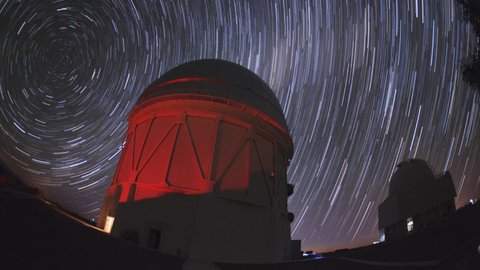
The DES uses multiple techniques to measure and study dark energy, the putative driving force of cosmic acceleration. Specifically, the DES studies dark energy through its impact on the abundance of galaxy clusters, weak gravitational lensing signals, type Ia supernovae and detections of large-scale correlations between galaxies. The combination of these various approaches will allow DES scientists to gain a more robust understanding of the current cosmological paradigm.
The survey uses a powerful wide-field imaging camera called the Dark Energy Camera, or DECam, which was installed in 2012 on the 4-meter Blanco telescope in Chile. During its five-year campaign (2013-2018), the DECam imaged approximately 5000 square degrees of the sky using five broadband filters, taking advantage of the excellent viewing conditions available on Cerro Tololo.
The final DES dataset will consist of precise photometric and morphological information for over 200 million galaxies at redshifts as deep as 2.0. The survey is also periodically revisiting smaller patches of sky to find and study over 2500 Type Ia supernovae.
KIPAC researchers working on DES are directly involved in calibrating the DES imaging data, in running massive computer simulations of the Universe and DES data, and in several aspects of the analysis and processing of the DES data. The scientific focus of DES members at KIPAC includes weak gravitational lensing, clusters of galaxies, galaxy evolution, and substructure within the Milky Way.
For more information about DES, see the collaboration website.
Related Research Areas

Cosmic Ecosystems
Cosmologists at KIPAC study the structure of the Universe from nearby galaxies and their satellites to the distribution of galaxies on the largest scales across the Universe.
Physics of the Universe
At KIPAC, we are working to understand the physics that shapes the origins, evolution and fate of the Universe.Related People
-
Steven Allen
Professor of Physics and of Particle Physics and Astrophysics -

David Burke
Professor of Particle Physics and Astrophysics, Emeritus -

Rebecca C. Chen
Postdoctoral Scholar -

Tara Dacunha
Ph.D. Student -
Joshua Frieman
Professor of Particle Physics and Astrophysics and, by courtesy, of Physics -

Yijung Kang
Res Assoc-Rubin Observatory -

Adam Mantz
Physical Science Research Scientist -

Andrés A. Plazas Malagón
Rubin Operations Scientists -
Aaron Roodman
Professor of Particle Physics and Astrophysics -
Eli S. Rykoff
Lead Scientist -
Rafe Schindler
Professor of Particle Physics and Astrophysics, Emeritus -
Risa Wechsler
Director, Kavli Institute for Particle Astrophysics and Cosmology (KIPAC), Humanities and Sciences Professor, Professor of Physics and of Particle Physics and Astrophysics, and Senior Fellow at Stanford HAI


