

Main content start
John Franklin Crenshaw
Postdoctoral Scholar, Physics
I am a Rubin Postdoctoral Fellow at the Kavli Institute for Particle Astrophysics and Cosmology (KIPAC) at Stanford University and SLAC National Accelerator Laboratory.
I study the large scale structure of the universe to extract information about fundamental physics and our cosmic origins. I am particularly interested in the high-redshift universe and using Lyman-break Galaxies (LBGs) and CMB lensing to constrain cosmology in the matter-dominated era. I created and lead the LBG Topical Team of the Dark Energy Science Collaboration (DESC) of the Vera C. Rubin Observatory's Legacy Survey of Space and Time (LSST). I also work on DESC's weak lensing analysis, particularly on pipelines, simulations, and validation for photo-z estimation and on photometric error modeling for simulated multi-survey catalogs.
I am also a member of the Rubin Observatory's active optics team. The active optics system applies real-time corrections to the telescope's optical alignment and mirror figure to optimize image quality for precision science, and is particularly vital for weak lensing and large-scale structure cosmology. I am primarily focused on wavefront estimation (i.e., inferring the presence of optical aberrations from Rubin images) and commissioning the active optics control system. I have spent many nights on the summit observing with and commissioning the Rubin Observatory.
I received my PhD at the University of Washington, advised by Prof. Andy Connolly. Before that, I completed my undergraduate studies at Duke University, where I was a Duke Faculty Scholar working with Prof. Kate Scholberg in the Duke Neutrino and Cosmology Group.
In my free time I enjoy alpine climbing, backcountry skiing, and watching way too many movies.
Note that I have a double name and go by "John Franklin" or "JF", not just "John".
I study the large scale structure of the universe to extract information about fundamental physics and our cosmic origins. I am particularly interested in the high-redshift universe and using Lyman-break Galaxies (LBGs) and CMB lensing to constrain cosmology in the matter-dominated era. I created and lead the LBG Topical Team of the Dark Energy Science Collaboration (DESC) of the Vera C. Rubin Observatory's Legacy Survey of Space and Time (LSST). I also work on DESC's weak lensing analysis, particularly on pipelines, simulations, and validation for photo-z estimation and on photometric error modeling for simulated multi-survey catalogs.
I am also a member of the Rubin Observatory's active optics team. The active optics system applies real-time corrections to the telescope's optical alignment and mirror figure to optimize image quality for precision science, and is particularly vital for weak lensing and large-scale structure cosmology. I am primarily focused on wavefront estimation (i.e., inferring the presence of optical aberrations from Rubin images) and commissioning the active optics control system. I have spent many nights on the summit observing with and commissioning the Rubin Observatory.
I received my PhD at the University of Washington, advised by Prof. Andy Connolly. Before that, I completed my undergraduate studies at Duke University, where I was a Duke Faculty Scholar working with Prof. Kate Scholberg in the Duke Neutrino and Cosmology Group.
In my free time I enjoy alpine climbing, backcountry skiing, and watching way too many movies.
Note that I have a double name and go by "John Franklin" or "JF", not just "John".
Research Projects

Artificial Intelligence and Machine Learning
At KIPAC, researchers are working to advance the frontiers of astronomy through the application of AI and machine learning, and simultaneously pushing the frontiers of AI/ML methods in pursuit of astrophysics discovery.
Dark Energy Spectroscopic Instrument
DESI is the heart of a ground-based survey that will spend the first half of the next decade pinpointing the locations and spectra of up to 35 million galaxies and 2.4 million quasars across one-third of the night sky.
NSF-DOE Vera C. Rubin Observatory's Legacy Survey of Space and Time
The Legacy Survey of Space and Time (LSST) is a 10-year survey of the southern sky that is taking place at the NSF-DOE Vera C. Rubin Observatory, located on the El Peñon peak of Cerro Pachón in northern Chile.
Nancy Grace Roman Space Telescope
The Nancy Grace Roman Space Telescope (formerly the Wide Field Infrared Survey Telescope, or WFIRST) is a mission designed to study dark energy, the evolution of galaxies, and the populations of extrasolar planets.Education
B.S., Duke University, Physics (2019)
M.S., University of Washington, Physics (2020)
Ph.D., University of Washington, Physics (2025)
Related News
-
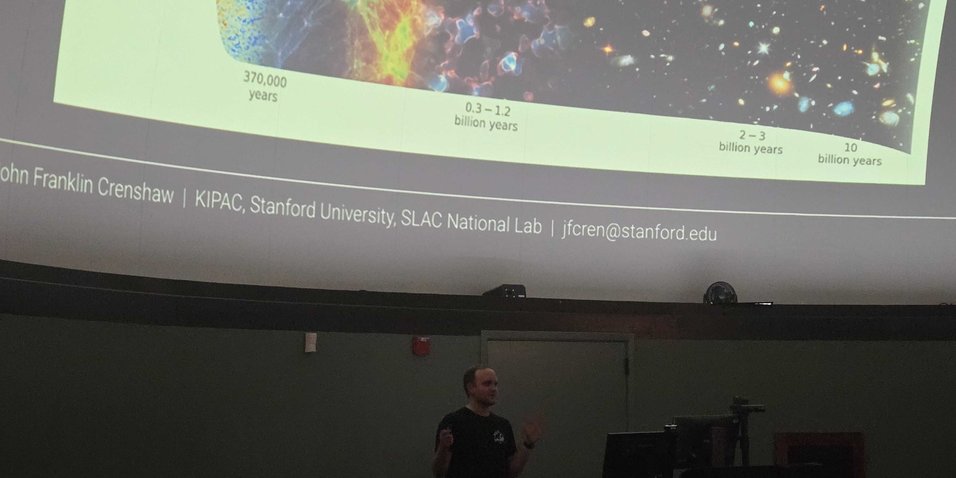
KIPAC's Rubin Observatory Public Engagement Series Continues at De Anza College Planetarium
Apr 24, 2026The second in our 2026 lecture series was a sold out event at the De Anza College Planetarium -
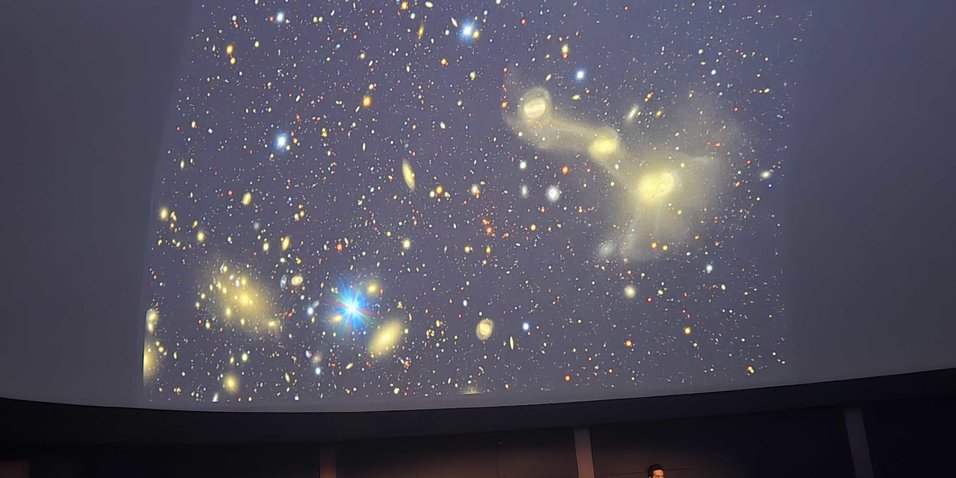
KIPAC's Rubin Observatory Public Engagement Series Kicks Off in San Mateo!
Mar 9, 2026The first in our 2026 lecture series kicked off with a sold out event at the College of San Mateo Planetarium