Nancy Grace Roman Space Telescope
The Nancy Grace Roman Space Telescope (formerly the Wide Field Infrared Survey Telescope, or WFIRST) is a mission designed to study dark energy, the evolution of galaxies, and the populations of extrasolar planets. A smaller version was the leading recommended large space-based project in the recent decadal survey and was later expanded to use a 2.4-m primary mirror. A 300-megapixel infrared camera gives it a field of view a hundred times larger than the Hubble Space Telescope, allowing unprecedented surveys of the infrared sky.
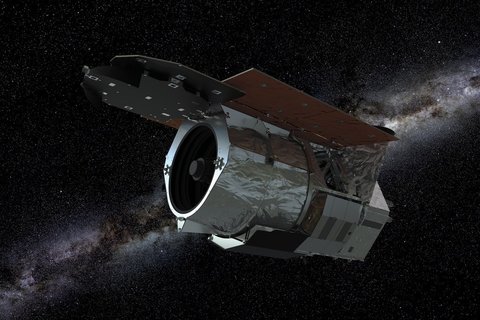
Studying the galaxies and supernova will measure the dark-energy driven expansion history. Studies of populations of stars and galaxies across cosmic time will help understand how they form. Gravitational microlensing will detect otherwise-invisible planets orbiting distant stars. The Roman Space Telescope is currently scheduled to launch in the late 2025, while the Legacy Survey of Space and Time (LSST) 10-year survey is underway. The complementarity of a ground-based visible-light survey with a space-based infrared survey presents a compelling opportunity to enhance what we learn about the universe. KIPAC scientists are involved in planning for studies of galaxy formation and dark energy with Roman.
The Roman Telescope will also carry the first advanced coronagraph into space. Using technology similar to the Gemini Planet Imager, it will block the light of bright stars to allow detection of faint nearby planets, laying the groundwork for future missions that will someday study Earthlike planets. Bruce Macintosh co-led a Science Investigation Team for the coronagraph, helping define its capabilities and identify potential science programs and targets for observation while it demonstrates the technology.
Related Research Areas

Cosmic Ecosystems
Cosmologists at KIPAC study the structure of the Universe from nearby galaxies and their satellites to the distribution of galaxies on the largest scales across the Universe.
Physics of the Universe
At KIPAC, we are working to understand the physics that shapes the origins, evolution and fate of the Universe.Related People
-

Rebecca C. Chen
Postdoctoral Scholar -

John Franklin Crenshaw
Postdoctoral Scholar -

Andrés A. Plazas Malagón
Rubin Operations Scientists -

Kevin Reil
Senior Scientist -

Risa Wechsler
Director, Kavli Institute for Particle Astrophysics and Cosmology (KIPAC), Humanities and Sciences Professor, Professor of Physics and of Particle Physics and Astrophysics, and Senior Fellow at Stanford HAI


