
NSF-DOE Vera C. Rubin Observatory's Legacy Survey of Space and Time
The Legacy Survey of Space and Time (LSST) is a 10-year survey of the southern sky at NSF-DOE Vera C. Rubin Observatory, funded by the U.S. National Science Foundation and the U.S. Department of Energy's Office of Science, located on the El Peñon peak of Cerro Pachón in northern Chile. LSST officially began on June 30, 2026, marking the start of a decade of survey data that will enable researchers around the world to better evaluate a wide range of pressing questions about the attributes of dark energy and dark matter, the formation of the Milky Way, the properties of small bodies in the solar system, the trajectories of potentially hazardous asteroids and the possible existence of undiscovered explosive phenomena.
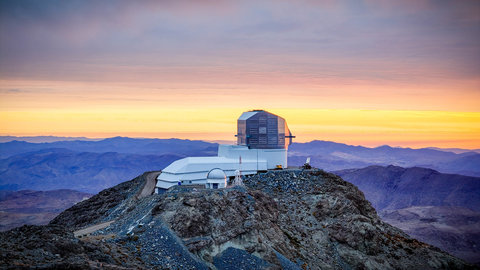
The telescope at the Rubin Observatory is the Simonyi Survey Telescope (SST) a large-aperture, wide-field, ground-based telescope that surveys half the sky every three nights in six optical bands ranging from 320 to 1050 nm. Its three large mirrors are actively controlled to minimize distortions. The telescope mount is a compact, still structure especially designed to reduce image motion.
Mounted on the SST is the DOE’s LSST Camera, which uses three refractive lenses to illuminate a 9.6-square degree field of view, and is the largest digital camera ever constructed. In full survey operations, the camera takes a pair of 15-second exposures of each field, scanning the sky throughout the entire night.

Simulations demonstrate that the telescope and camera can deliver a uniform and deep (24.5 magnitude in r-band for one 15s exposure) 18,000 square degree survey and will produce over 5.2 million exposures in ten years. This "movie," which is sensitive to redshifts of up to z=3, opens an entirely new window on the Universe: the time domain. The Rubin Observatory produces, on average, 15 terabytes of LSST data per night, yielding an uncompressed data set of 200 petabytes. Dedicated facilities process the image data in near real time.
KIPAC members have leading roles in project areas, including the observatory, the camera, the LSST Dark Energy Science Collaboration (DESC), and the US Data Facility, and are also working on science preparation for a broad range of topics. SLAC is the lead lab for the LSST Camera construction and commissioning, the host lab for DESC, and one of two partners (along with NSF's NOIRLab) in the operations of Rubin Observatory, including managing and hosting the Rubin US Data Facility.
Rubin Observatory
The construction of the LSST Camera has been led by KIPAC / SLAC members since its inception by KIPAC Professor Steve Kahn; Steve was Director of the NSF-DOE Vera C. Rubin Observatory construction project from 2013 (when LSST stood for Large Synoptic Survey Telescope) through 2021. KIPAC Professor Aaron Roodman assumed the role of Camera Program Leader and is also Rubin Observatory Deputy Director as of 2022. Other KIPAC members have taken leading roles in instrument design, construction, commissioning, and operations: Phil Marshall is Deputy Director of Rubin Operations, Adam Bolton is Rubin Operations US Data Facility Lead, and Kevin Reil is both the Rubin Observatory Scientist and the Deputy Associate Director of (Rubin) Summit Operations. Rubin Observatory is much more than a dome on a mountain top: it is an end-to-end scientific data generation system, a factory for producing science-ready data products from the biggest astronomical sky survey ever undertaken.
The LSST Camera
The LSST Camera was built by a team at SLAC National Accelerator Laboratory working with a broad multi-institutional collaboration. KIPAC professor Aaron Roodman led the camera's Integration and Test (I&T) up until 2021, when KIPAC scientist Andy Rasmussen assumed the role of I&T Scientist. The camera’s 3.2-gigapixel focal plane array comprises 189 4Kx4K CCD sensors with 10 µm pixels. The sensors are deep depletion, back-illuminated devices with a highly segmented architecture that enables the entire array to be read out in two seconds. The detectors are grouped into 3 x 3 arrays called "rafts." The rafts are identical, with each containing its own dedicated front- and back-end electronics boards which fit within the footprint of its sensors, thus serving as a 144-megapixel camera on its own. The rafts and associated electronics are mounted on a silicon carbide grid inside a cryostat vacuum, with an intricate thermal system that maintains the CCDs at an operating temperature of -100 ºC. The focal plane also contains four sets of guide sensors and wavefront sensors. The LSST Camera was shipped to Chile in May 2024. Many KIPAC scientists have played key roles in the commissioning of the LSST camera and the Rubin “active optics” system over the past two years.
The Rubin US Data Facility
Image data from Rubin Observatory's Summit Facility is transmitted to the Rubin US Data Facility at SLAC for near real-time processing, to generate millions of alerts per night, for filtering and analysis by scientists across the world. Each year, the survey images taken to date will be reprocessed, combined and automatically measured to yield an increasingly deep picture of the whole Southern sky, and a growing catalog of astronomical objects that captures how each one has changed over time. This annual data release processing will be run at three data facilities, in France, the UK, and at SLAC, with the final dataset assembled at SLAC and served to astronomers and physicists via the Rubin Science Platform. SLAC staff are involved in all aspects of this process, making KIPAC one of the best places in the world to do LSST science.
The LSST Dark Energy Science Collaboration (DESC)
Eight scientific collaborations have been actively preparing to take advantage of the publicly available LSST data. KIPAC members are deeply involved in the LSST Dark Energy Science Collaboration (DESC), which seeks to characterize dark energy, the enigmatic force thought to be responsible for accelerating the expansion of the Universe. DESC uses five different cosmological probes on LSST data, including weak and strong gravitational lensing, galaxy clustering, supernovae, and large-scale structure, to create a more accurate picture of the expansion history of the Universe. Such a picture could help cosmologists constrain the behavior of dark energy and determine which models can explain it. As host lab, SLAC is home to the DESC Operations team of scientists and computing professionals leading the development, operation and maintenance of the collaboration's cosmology analysis and simulation software pipelines. Seth Digel is the DESC Operations Manager, while Jim Chiang and Pat Burchat have served as Computing and Technical Coordinators overseeing the preparations for DESC's LSST-scale analysis computations and helping forge the needed connections between the collaboration and the observatory during both commissioning and survey operations. Numerous current and former KIPAC members have led DESC working groups focused on specific technical and scientific challenges. KIPAC students, postdocs, staff and faculty are active and enthusiastic members of DESC, working together with hundreds of colleagues around the world to make LSST dark energy science happen. Many KIPAC members are also thinking about the breadth of science opportunities that the Rubin Observatory will enable, from exoplanet science to optical counterparts of gravitational waves and identification of a wide variety of transient objects.
You can learn more at the Rubin Observatory and LSST website, including about the LSST camera, and read about DESC and its science at the LSST DESC webpage.
News
-
Telescope with Bay Area roots becomes part of project to scan the universe
Jul 3, 2026An ambitious project to scan the universe has ties to the Bay Area. -
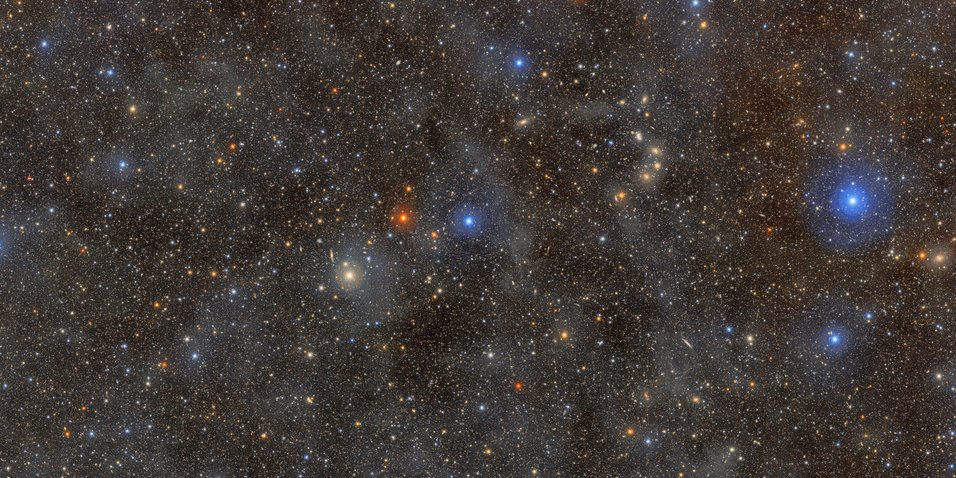
NSF-DOE Vera C. Rubin Observatory begins capturing a ‘movie’ of the cosmos
Jun 30, 2026Rubin’s 10-Year Legacy Survey of Space and Time will scan the night skies to create a time-lapse record of the Universe. -
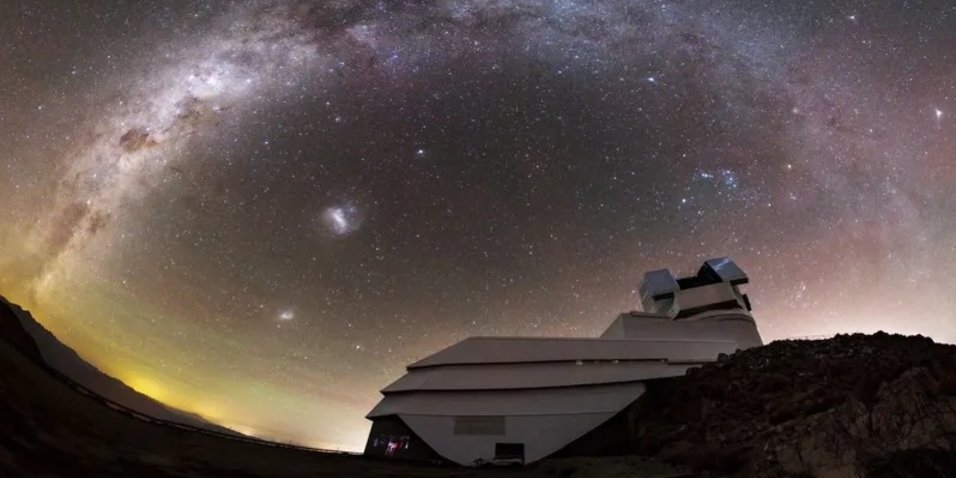
Vera C. Rubin Observatory days away from launching decade-long sky survey
Jun 17, 2026After years of construction and months of testing, the Chilean mountaintop telescope is nearly ready to begin the most ambitious astronomical survey ever attempted.
Related Research Areas

Cosmic Ecosystems
Cosmologists at KIPAC study the structure of the Universe from nearby galaxies and their satellites to the distribution of galaxies on the largest scales across the Universe.
Physics of the Universe
At KIPAC, we are working to understand the physics that shapes the origins, evolution and fate of the Universe.Related People
-

Steven Allen
Professor of Physics and of Particle Physics and Astrophysics -

Shreya Anand
Postdoctoral Scholar -

Jay Baptista
Ph.D. Student -
Roger Blandford
Luke Blossom Professor in the School of Humanities and Sciences, and Professor of Physics and of Particle Physics and Astrophysics -
Alex Broughton
Rubin Ops Research Associate -

Patricia Burchat
Gabilan Professor -

Eric Charles
Staff Scientist -

Rebecca C. Chen
Postdoctoral Scholar -
James Chiang
Lead Scientist -

Ani Chiti
Postdoctoral Scholar -

John Franklin Crenshaw
Postdoctoral Scholar -

Tara Dacunha
Ph.D. Student -
Seth Digel
Senior Scientist -

Richard Dubois
Emeritus Staff, KIPAC Senior Associate Member -

Orion Eiger
Software Developer, SLAC -

Lukas Eisert
Rubin Observatory Specialist -
Kevin M. Fanning
Res Assoc-Rubin Observatory -

Joshua Frieman
Professor of Particle Physics and Astrophysics and, by courtesy, of Physics -
Shenming Fu
Rubin Ops Research Associate -
Thomas L. Glanzman
Staff Scientist -
Sven Herrmann
Physical Science Research Scientist -

Minhee Hyun
Postdoctoral Scholar -
John Bryce Kalmbach
Rubin Operations Scientists -

Yijung Kang
Res Assoc-Rubin Observatory -
Heather Kelly
Software Developer, SLAC -

Narayan Khadka
Rubin Observing Specialist -

Shun-Sheng Li
Postdoctoral Scholar -

Shuang Liang
Research Associate -
Grzegorz M. Madejski
Lecturer -

Adam Mantz
Physical Science Research Scientist -

Phil Marshall
Senior Scientist -
Stuart L. Marshall
Lead Scientist -
Joshua Evan Meyers
Rubin/LSST DESC Ops Scientist -

Glenn Morris
Software Developer -

Kate Napier
Res Assoc-Rubin Observatory -
Homer Neal
Staff Scientist, SLAC -

Andrés A. Plazas Malagón
Rubin Operations Scientists -
Andrew Peter Rasmussen
Staff Scientist -

Maya Redden
Ph.D. Student -
Kevin Reil
Senior Scientist -
Aaron Roodman
Professor of Particle Physics and Astrophysics -
Eli S. Rykoff
Lead Scientist -
Noah Sailer
Postdoctoral Scholar -

Emmanuel S Schaan
Assistant Professor of Particle Physics and Astrophysics -

Rafe Schindler
Professor of Particle Physics and Astrophysics, Emeritus -

Risa Wechsler
Director, Kavli Institute for Particle Astrophysics and Cosmology (KIPAC), Humanities and Sciences Professor, Professor of Physics and of Particle Physics and Astrophysics, and Senior Fellow at Stanford HAI -
Zhuoqi Zhang
Ph.D. Student


