
Computational Astrophysics
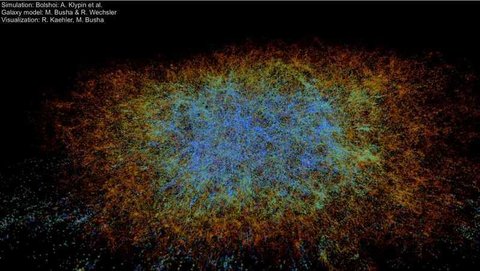
Computational methods are central to astrophysics at KIPAC. Simulations serve as a third pillar of science alongside theory and observation — the only way to study phenomena that unfold over billions of years or occur in environments impossible to recreate in any laboratory. By encoding the physics of gravity, gas dynamics, magnetic fields, radiation, and dark matter into numerical algorithms, KIPAC researchers can follow the evolution of cosmic structure from the first moments after the Big Bang to the present day, and compare these virtual universes to observed data.
KIPAC researchers develop and run simulations across an enormous range of scales and physical regimes:
Cosmological Structure and the Galaxy-Halo Conenction
Large-volume cosmological simulations track the growth of dark matter structure and the formation of galaxies across cosmic time. KIPAC researchers have developed large simulation suites and galaxy-halo connection models that are central to interpreting data from major surveys including DES, DESI, and Rubin LSST. These simulations, combined with machine-learning emulators, enable precision cosmological inference that would otherwise be computationally intractable. Zoom-in simulations of Milky Way-mass halos probe the small-scale structure of dark matter and the formation of dwarf galaxies, testing models for dark matter's particle nature.
First Stars and Cosmic Reionization
Adaptive mesh refinement simulations capture the formation of the first luminous objects in the universe — massive stars that formed from primordial gas just 100 million years after the Big Bang. These simulations span more than 14 orders of magnitude in length scale, following the collapse of gas from cosmological scales down to the birth of individual stars. KIPAC researchers study how these first stars seeded the cosmos with heavy elements and initiated the reionization of the intergalactic medium.
Galaxy Formation and Hydrodynamics
Hydrodynamic simulations follow the complex interplay of gas, stars, dark matter, and feedback processes that shape galaxies. KIPAC researchers have pioneered methods for simulating galaxy formation with high resolution, capturing the turbulent interstellar medium, star formation, supernova feedback, and the amplification of magnetic fields. These simulations reveal how galaxies acquire their structure, how stellar feedback regulates star formation, and how magnetic fields become dynamically important even when starting from negligible initial seeds.
Compact Objects and Plasma Astrophysics
Kinetic plasma simulations and general relativistic magnetohydrodynamics (GRMHD) codes model the extreme environments around black holes and neutron stars. KIPAC researchers have developed models explaining the coherent radio emission of pulsars, the electromagnetic flares from magnetars and merging neutron stars, and the dynamics of relativistic jets from accreting black holes. These simulations require coupling Einstein's general relativity with the physics of high-energy plasmas in some of the most extreme conditions in the universe.
Algorithmic Development
Pushing the frontiers of computational astrophysics requires developing new numerical methods. KIPAC researchers pioneer novel algorithms for following collisionless fluids like dark matter, for coupling radiation transport to hydrodynamics, and for modeling plasmas in curved spacetime. These methods enable simulations that were previously impossible and often find applications beyond astrophysics.


Related Research Areas
Related Research Areas

Cosmic Ecosystems
Cosmologists at KIPAC study the structure of the Universe from nearby galaxies and their satellites to the distribution of galaxies on the largest scales across the Universe.
Extreme Astrophysics
We at KIPAC have an active Compact Object Group Meeting (COG) which meets Tuesdays to discuss progress in extreme astrophysics.
Physics of the Universe
At KIPAC, we are working to understand the physics that shapes the origins, evolution and fate of the Universe.Related People
-

Tom Abel
Professor of Particle Physics and Astrophysics and of Physics -

Jay Baptista
Ph.D. Student -
Roger Blandford
Luke Blossom Professor in the School of Humanities and Sciences, and Professor of Physics and of Particle Physics and Astrophysics -

Chris Byrohl
Postdoctoral Scholar -

Tara Dacunha
Ph.D. Student -
Ben Dodge
Ph.D. Student -

Lukas Eisert
Rubin Observatory Specialist -
Philip Mansfield
Physical Science Research Scientist -

Eric Moseley
Postdoctoral Scholar -

Benjamin Nachman
Associate Professor of Particle Physics and Astrophysics and, by courtesy, of Physics and of Statistics -

Sasha Philippov
Associate Professor of Physics -

Navin Sridhar
Postdoctoral Scholar -
Kate Storey-Fisher
Postdoctoral Scholar -
Risa Wechsler
Director, Kavli Institute for Particle Astrophysics and Cosmology (KIPAC), Humanities and Sciences Professor, Professor of Physics and of Particle Physics and Astrophysics, and Senior Fellow at Stanford HAI


