Probing the Elements Produced by the First Stars

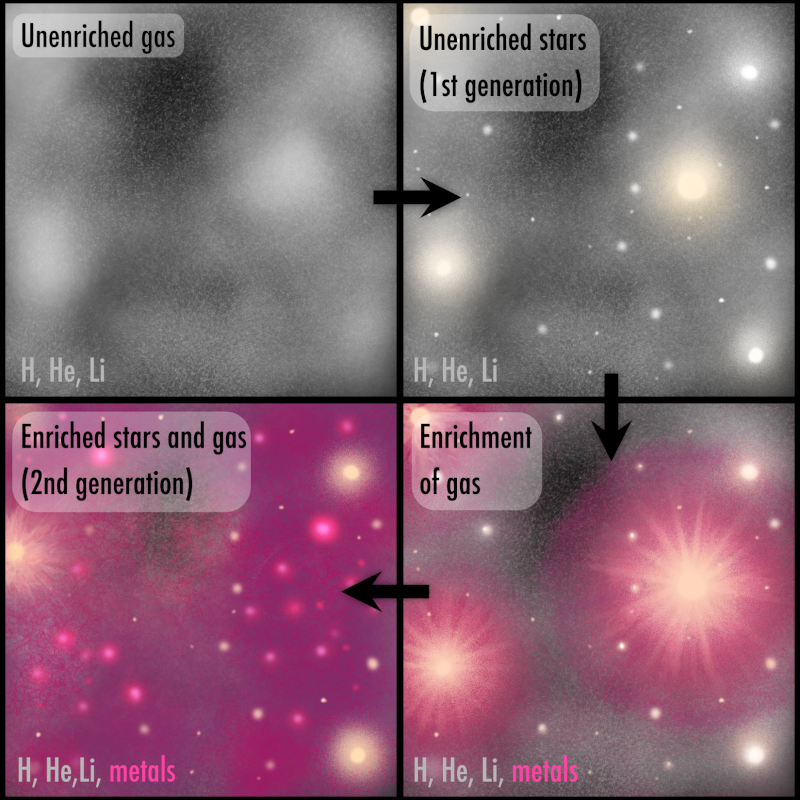
Imagine a universe devoid of the elements we associate with modern life — carbon, oxygen, iron, neon — or in fact, any elements apart from hydrogen, helium, and lithium. That was the state of the Universe up until the formation of the first stars, around a hundred million years after the Big Bang. These stars began forging the first heavy elements through nuclear fusion in their cores, and then dispersed these elements into the Universe through dramatic explosions at the ends of their lives. This process continued for the next thirteen billion years to form many of the elements we see today, but this initial transition happened at the time of the first stars. We can find relics from this time around our own Galaxy, the Milky Way, that preserve the elements produced by the first stars and allow us to reconstruct this transition in detail.
The first billion years of the Universe
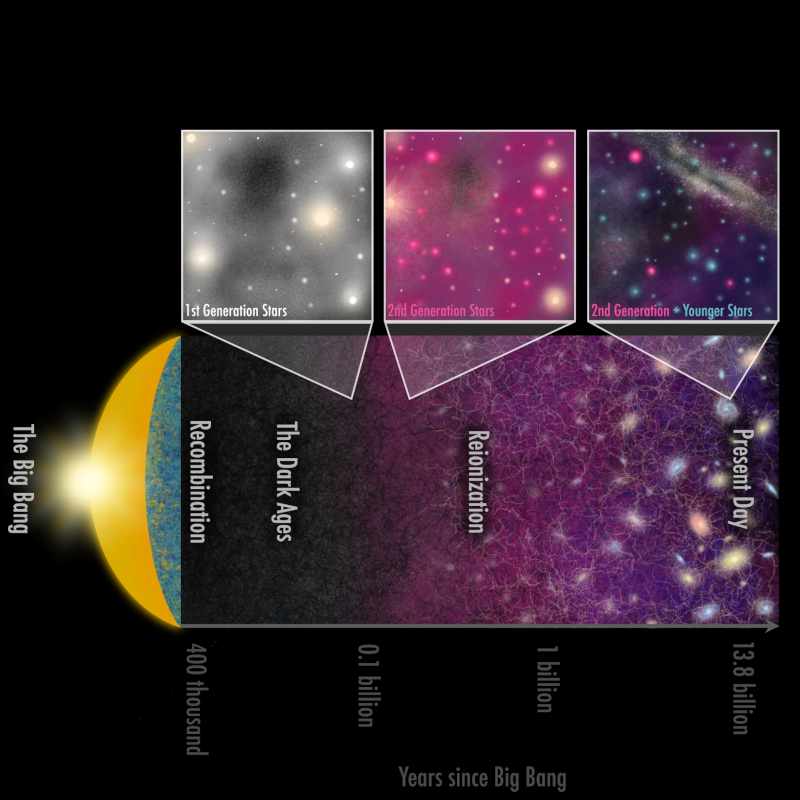
The first stars emerged from the darkness and chemical simplicity of the early Universe within its first billion years. Without heavy elements to cool the gas clouds that formed them, these stars grew to tens or hundreds of times the mass of our Sun, quickly exploded as supernovae, and seeded the cosmos with its first heavy elements.
Given their short lifetimes, we likely cannot observe the first stars directly. But the elements they produced mixed into the surrounding gas that created the next generation of stars. Some of these second-generation stars still exist today, and their surfaces retain the chemical signatures of the first supernovae. These stars are incredibly rare, but provide a direct window on initial element production in the Universe.
In a recent paper published in Nature Astronomy, our team chronicled the discovery and characterization of the first clear second-generation star within a primordial dwarf galaxy. This object provides an observational window on what elements and nucleosynthetic mechanisms seeded the small-scale galaxies that inhabited the early Universe.
Galactic archaeology — Finding time capsules from the early Universe
The elements in the Sun were likely produced by tens of thousands of supernovae, but ancient, second-generation stars preserve elements produced by just a single generation of supernovae. As a result, these primordial stars can be identified through the minuscule amounts of heavy elements (i.e., “metallicity”) in their spectra. Our team searches for these objects using the MAGIC survey, which is imaging a quarter of the southern hemisphere using the Dark Energy Camera on the Víctor Blanco 4m Telescope in Chile. MAGIC uses a special narrow-band imaging filter centered on prominent absorption lines of calcium, which serve as a proxy for the overall heavy element content. Stars with less calcium have weaker absorption lines and thus appear brighter in this filter, meaning that images taken by MAGIC can be used to systematically map the distribution of primordial, low-metallicity stars across a significant fraction of the sky. Upon discovering candidate stars from this imaging data, we then obtain detailed spectroscopy of these stars to tease out the elements produced by early stars in the infant Universe.
A relic star from the early Universe
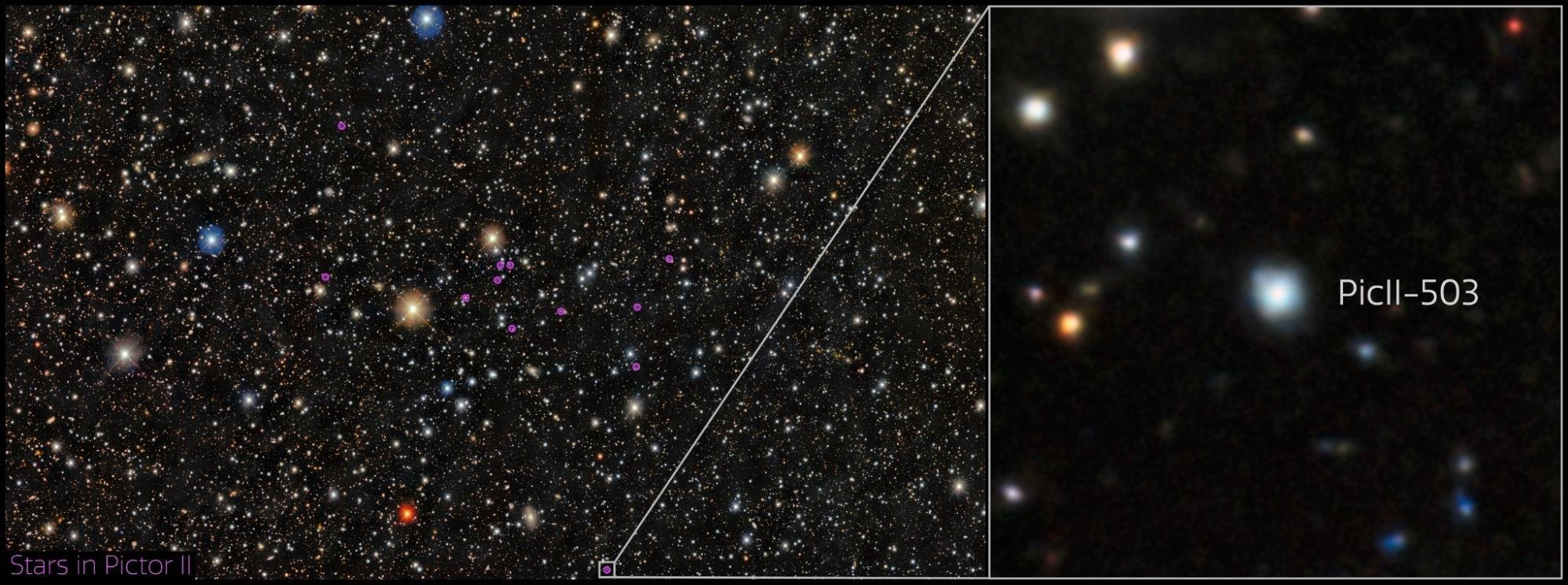
Recently, that survey flagged a candidate second-generation star labeled PicII-503 in the outskirts of the Pictor II dwarf galaxy. The Pictor II galaxy only contains a few thousand stars — compared to the Milky Way’s billions — and is known as an ultra-faint dwarf galaxy, a class of systems that formed in the early universe and are currently orbiting the Milky Way. Thus far, no clear second-generation star had been discovered in one of these tiny galaxies, leaving an observational gap in tracing how the first elements were produced and preserved within the tiny galaxies that formed in the primordial Universe.
When we pointed spectrographs at PicII-503 — first the MagE spectrograph on the Magellan Telescopes, and then the X-Shooter spectrograph on the Very Large Telescope — we found that PicII-503 was the most chemically primordial star known outside the Milky Way. It contains less than 1/40,000th of the relative iron content of the Sun. At the same time, it had an enormous overabundance of carbon relative to other heavy elements, with more than 1,500 times the relative carbon-to-iron content of the Sun. However, we did not detect any other elements in the star down to the limits of our spectroscopy, apart from trace amounts of calcium (~1/160,000th relative to the Sun). These data show that a massive overproduction of carbon is one pathway by which elements can be initially produced and retained within primordial systems. One mechanism that can produce this peculiar signature is a low-energy supernova, where the progenitor star preferentially ejects material like carbon in its outer layers. We know of several dozen stars orbiting the Milky Way that also show this extreme carbon-enhanced, hyper iron-deficient fingerprint; our observation demonstrates that these stars can originate from primordial dwarf galaxies absorbed into our own, and likely do preserve signatures from the first supernovae.
What are the pathways for the initial enrichment of the universe?
While we have shown with PicII-503 that one pathway for the initial enrichment of primordial environments is a large overproduction of carbon, this is certainly not the only mechanism. An open question is whether this signature depends on the environment at the time of formation. Some models hypothesize that this ought to be the case, since the smallest galaxies may preferentially retain low-energy explosions that produce carbon-rich material, and energetic supernovae may expel elements outside the gravitational potential of tiny systems. As MAGIC continues to identify stars across environments, we look forward to systematically mapping whether this is the case using active spectroscopic campaigns on the Magellan Telescopes in Chile through KIPAC-obtained time. In addition, the James Webb Space Telescope continues to push the frontier of the high-redshift Universe, now directly observing galaxies just a few hundred million years after the Big Bang. Naturally, galaxies that are observable at these early times need to be bright and massive to be detectable, providing a window on early enrichment in different environments relative to the dwarf galaxies around the Milky Way. We look forward to connecting the dots between these observational probes to reconstruct how the Universe came to be.
Edited by Lori Ann White, Jack Dinsmore, and Xinnan Du
Related Research Areas

Cosmic Ecosystems
Cosmologists at KIPAC study the structure of the Universe from nearby galaxies and their satellites to the distribution of galaxies on the largest scales across the Universe.Related People