
Solar, Stellar, and Planetary Astrophysics

How do stars form from the turbulent, magnetized gas and dust of the interstellar medium—and how do stellar feedback and magnetic activity shape their birth environments? How do planetary systems form and evolve, and what controls the diversity of planets we observe beyond our Solar System? How do the Sun and other stars vary over time, and how does stellar activity influence planetary atmospheres, habitability, and space weather? And how can we combine astronomical observations with Earth and planetary science to understand the interiors, climates, and long-term evolution of rocky worlds?
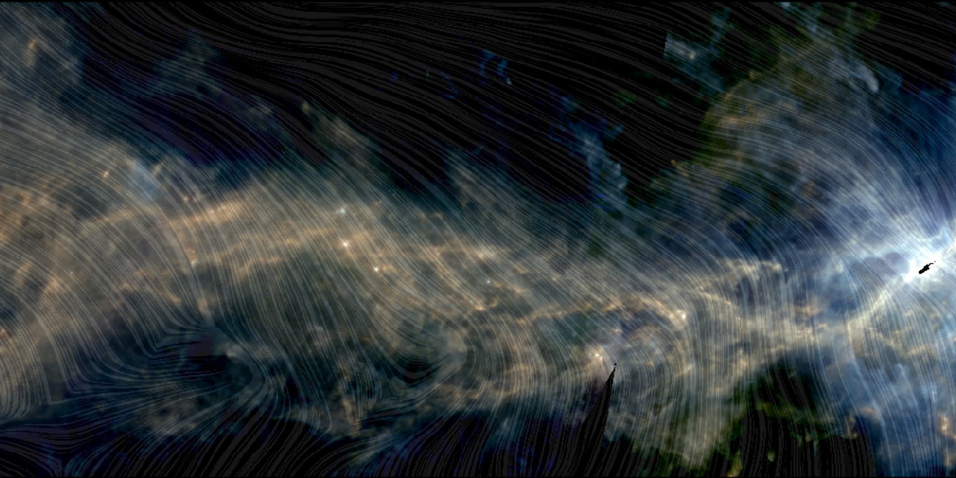
At KIPAC, we study the coupled evolution of stars, planets, and the environments that link them—from the turbulent, magnetized interstellar medium where stars are born, to exoplanetary systems, to the Sun and its influence on the heliosphere and Earth. We combine theory, simulation, and observations to model star formation and stellar magnetism, to detect and characterize exoplanets and their atmospheres, and to understand how stellar activity shapes planetary environments.
We collaborate with colleagues in Stanford’s Departments of Earth & Planetary Sciences and Geophysics to connect exoplanet observations to the physics of planetary interiors, atmospheres, and climate evolution. These cross-disciplinary efforts link astronomical measurements to the underlying physical and geochemical processes that shape rocky worlds and their habitability.
Solar Physics
The Sun is our closest laboratory for magnetized plasma physics and stellar variability, with direct impacts on the heliosphere and space weather at Earth. KIPAC researchers combine observations, theory, and simulations to study the Sun’s magnetic dynamo and activity cycle, the origin and variability of the solar wind, and the explosive energy release in flares and coronal mass ejections (CMEs). We also investigate high-energy, non-thermal processes in solar and heliospheric environments—how particles are accelerated, transported, and radiate—from flare sites and CMEs to galactic cosmic rays propagating through the heliosphere. Together, these efforts connect fundamental plasma processes to real-world consequences for satellites, communications, and space-based infrastructure.
Stellar Astrophysics and Magnetism
Stars are dynamic, magnetized engines whose activity shapes both their own evolution and the environments of their planets. KIPAC researchers study stellar variability, rotation, magnetic fields, and flares across a wide range of stellar types, using time-domain observations and models of stellar dynamos and magnetized atmospheres. This work helps place the Sun in a broader stellar context and improves our understanding of how magnetic activity evolves with age and influences planetary atmospheres.
Exoplanets and Planetary Systems
Exoplanets show remarkable diversity in size, composition, and orbital architecture, offering new tests of how planetary systems form and evolve. Through major contributions to direct-imaging instrumentation and analysis—particularly the Gemini Planet Imager (GPI)—KIPAC researchers have helped detect and characterize young exoplanets and circumstellar disks, and to use these observations to test models of planet formation.
Related projects

COFFIES DRIVE Science Center
COFFIES is a NASA-funded Phase II DRIVE Science Center with the goal of solving some of the most difficult mysteries hidden in the deep interior of our Sun.
Simons Observatory
Currently under construction in Chile’s Atacama Desert, the Simons Observatory (SO) is a next-generation observatory that will look for signs of cosmic inflation and answer fundamental questions about the origin of the Universe.Related Research Highlights

Related People
-

J. Hoeksema
Professor (Research) of Physics -

Yijung Kang
Res Assoc-Rubin Observatory -

Vahe Petrosian
Professor of Physics and of Applied Physics -

Roger Romani
Professor of Physics -

Laura Schaefer
Associate Professor of Earth and Planetary Sciences, by courtesy, of Geophysics -

Dustin Schroeder
Professor of Geophysics, of Electrical Engineering and Senior Fellow at the Woods Institute for the Environment -

Junwei Zhao
Senior Research Scientis - Physical Science


