Not just summer students: Undergrads bring game to research all year ‘round

by Lori Ann White
Summer is undergrad season at universities and research institutes. A plethora of programs exist that place enthusiastic, ambitious undergraduates with scientist-mentors who can provide them with an introduction to scientific research and keep them busy over the summer months.
But ambitious undergrads are often ambitious 12 months out of the year, not three. David Wendt and Arlene Aleman are just two of the undergrads who have demonstrated how much a motivated undergraduate can contribute to a research project during the school year.

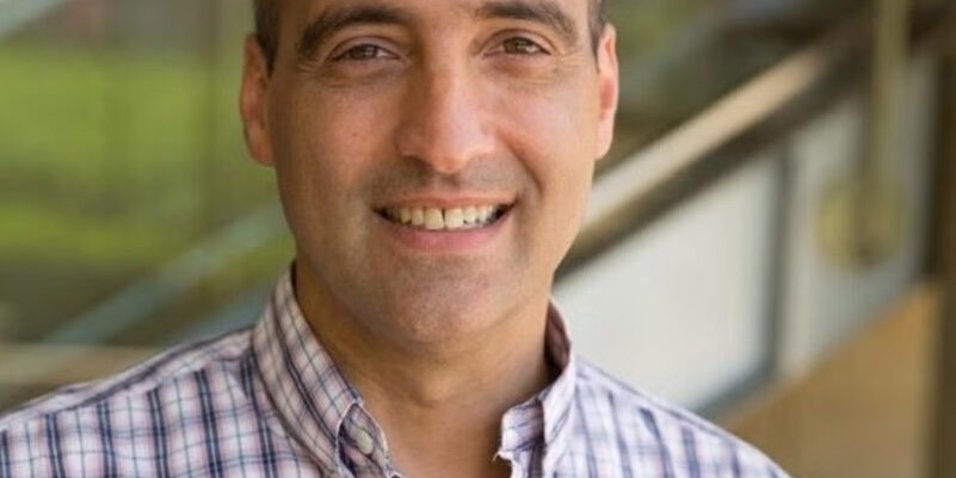
David Wendt, a Stanford Computer Science coterminal student who graduated last spring, worked with KIPAC Professor Roger Romani.
Wendt began his undergraduate career at Stanford in physics. A special interest in high-energy physics led to an internship with ATLAS, one of the primary Higgs-detecting projects at the Large Hadron Collider at CERN. As his schooling progressed, however, he grew interested in scientific computing, then computing for its own sake, although he never lost his appreciation for physics.
“It prepared me extremely well for any kind of quantitative subject,” Wendt says.
During the winter of his sophomore year, Wendt learned of Romani’s penchant for pushing the boundaries of fundamental physics using neutron stars, which are the heaviest single objects in the Universe that aren’t black holes. Wendt found his interest in astrophysics piqued to the point he took Romani’s class in cosmology and high-energy astrophysics and began to work with him that summer. Deciding to take advantage of the growing sensitivity of pulsar timing array studies at detecting gravitational waves, they modeled the types of merging supermassive black holes (SMBHs) that might show up in the data first, work that continued during his junior year.
Counter to intuition, they discovered that more distant mergers might be discovered before much nearer mergers—as much as eight times farther, based on the data they analyzed. The results of the study were published in The Astrophysics Journal.
“I’m very happy a paper came out of it, though I’m not doing this for the paper, I did the research for its own sake,” says Wendt.
Wendt is undecided on whether to continue with astrophysics and cosmology. “I do want to explore my options,” he says.
Whatever he decides to do, Romani is sure he’ll succeed. “He’s a very impressive young man,” Romani says.
Arlene Aleman

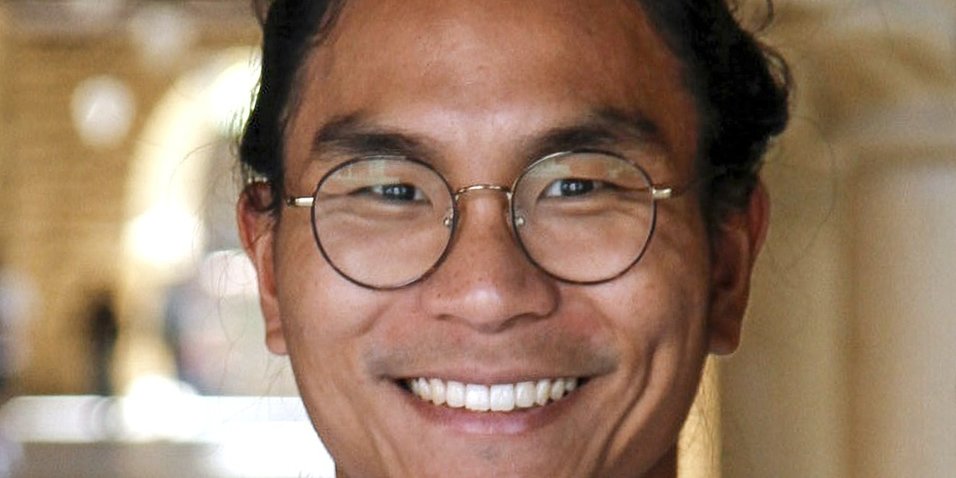
Arlene Aleman worked with former KIPAC Professor Bruce Macintosh. Aleman also wanted to explore her options, but didn’t want to stray beyond her major. “At the end of my junior year I wasn’t sure what I wanted to do with Physics,” Aleman says. “I figured it was time to try research.” She began applying for summer research positions and found an ideal opportunity close to home with the Gemini Planet Imager (GPI) team.
GPI had finished its stint at the Gemini South Telescope in Chile and was slated for upgrades before being mounted on the Gemini North Telescope in Hawaii (this work is ongoing). Aleman’s job was to help ensure the success of the project—“While with Bruce my first research project was doing simulations of the instrument to see the effects of the upgrades.”
“I got my start during the pandemic and over Zoom,” Aleman says, but it didn’t discourage her. What she had to overcome was self-doubt in the form of “Just an Undergrad Syndrome.”
“‘Me? I’m just an undergrad,’” Aleman remembers thinking. “‘They’re not going to care about my research. It won’t make any difference.’ But, she says, Macintosh was very supportive. “Bruce invited me to team meetings to share my findings.” He also invited her to continue her research with the group over the following year. The icing on the cake? “It was really cool seeing my name listed as a co-author on the paper."
According to Macintosh, she didn’t waste the opportunity. “It was great to have a year to work with her afterwards and get deeper into the research,” he says. Aleman also attended the AstroTech Workshop at Berkeley during the following summer to learn more about instrumentation.
The end result of her exposure to research with Macintosh and crew was life-changing. Literally. “Prior to doing research I thought I’d never do any more school again,” Aleman says. After her time on GPI, she found herself questioning that assumption. “Oh, man, do I want to do a PhD after all?”
The answer? A resounding “Yes!”
Now she’s at Notre Dame, well on her way to that doctorate. Also currently at Notre Dame? Her old friend GPI. “I’d still like to work on the instrument since it’s here,” Aleman says. “It would be a really cool continuation of my undergraduate work to help with the upgrade and finally see the instrument on sky.“
But regardless of whether she gets to work on GPI again, “I want to go into an intersectional part of astronomy,” she says. “Working with Bruce I learned about exoplanets but I also learned a lot about instrumentation. I’d like to stay in that intersection between exoplanets and instrumentation.”
“I always reflect on how lucky I was because it ended up being a perfect fit.”
A (non-exhaustive) list of summer research programs
Both Wendt and Aleman first met their mentors during a summer research program. Below are some options for undergrads interested in summer research at Stanford, whether or not you hope to follow in Wendt's and Aleman's footsteps. Your advisor can help you find others options.
But better move quickly; applications for the programs are often due at the beginning of the year.
- Student Undergraduate Laboratory Internships (Department of Energy)
- Cal-Bridge Summer Program
- Leadership Alliance—Summer Research Early Identification Program
- Stanford Undergraduate Research Program (Stanford Physics)
- Community College Internship (SLAC)
Related Research Areas

Cosmic Ecosystems
Cosmologists at KIPAC study the structure of the Universe from nearby galaxies and their satellites to the distribution of galaxies on the largest scales across the Universe.
Extreme Astrophysics
We at KIPAC have an active Compact Object Group Meeting (COG) which meets Tuesdays to discuss progress in extreme astrophysics.
Physics of the Universe
At KIPAC, we are working to understand the physics that shapes the origins, evolution and fate of the Universe.