Capturing the Dynamic Millimeter Universe

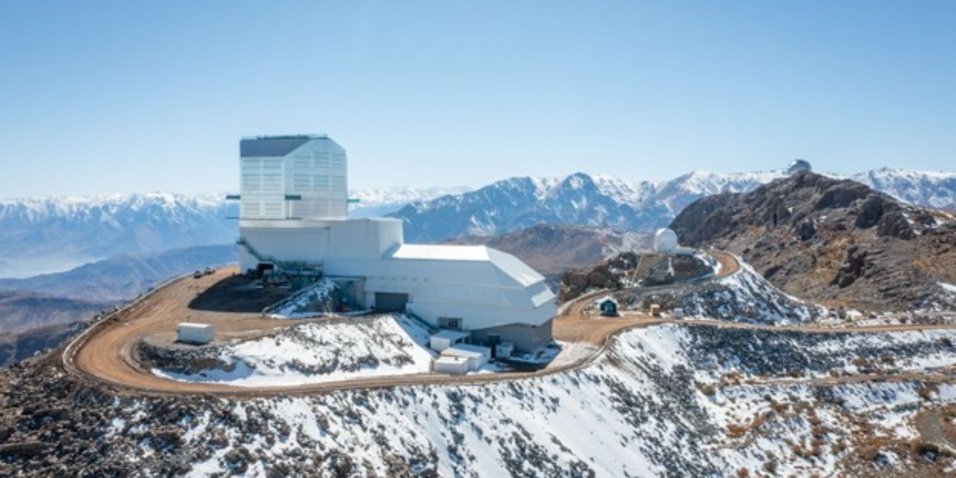
Much of our understanding of cosmology is anchored in observations of the cosmic microwave background (CMB), the oldest light in our Universe. These observations are the result of many generations of millimeter-wave experiments reaching back decades. The latest entry to these efforts is the Simons Observatory, a suite of telescopes standing high atop the Atacama Desert in Chile.
However, the millimeter sky contains far more than just a static image of the CMB, and an ongoing major upgrade to the Simons Observatory's 6-meter Large Aperture Telescope (LAT) will soon allow us to realize the full potential of the millimeter universe. This enhancement, enabled by a $52 million grant from the National Science Foundation, effectively doubles the number of sensors inside the LAT. This means we can survey the sky faster and more sensitively, allowing us to pierce deeper into the static CMB while simultaneously capturing the transient events that make up our dynamic Universe.

More detectors, more power
The upgraded LAT will be equipped with approximately 60,000 detectors, a tenfold increase over its predecessor, the Atacama Cosmology Telescope (ACT). This leap is achieved by completely filling the telescope’s wide field-of-view with 13 ACT-like “optics tube” cameras spanning 27 to 270 GHz, covering both the CMB signal and astrophysical foregrounds, and giving the LAT the statistical power to produce five years worth of ACT data in less than five months.
So what can we do with all of this power? For starters, we can make far more sensitive maps of the CMB. Deeper maps will reveal how galaxies and their dark matter halos scatter and bend the trajectories of CMB photons as they travel towards our telescopes. These secondary effects in the CMB allow us to better understand the conditions of the early Universe, and the distribution and evolution of structure in the late-time Universe.
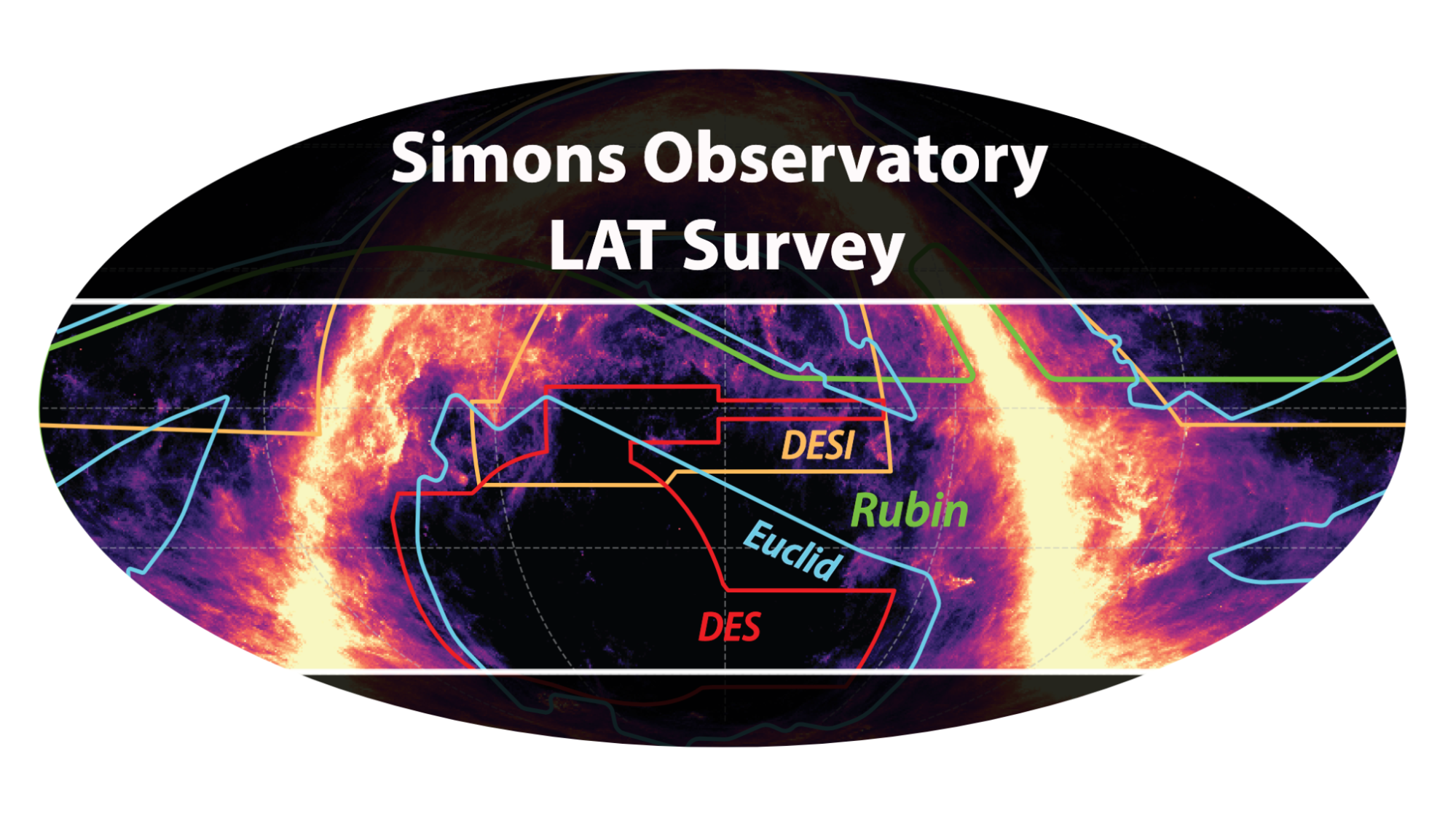
And the Simons Observatory won't be doing this in isolation. The LAT survey footprint covers about 60% of the sky, overlapping significantly with complimentary galaxy surveys like the Rubin Observatory Legacy Survey of Space and Time (Rubin) and the Dark Energy Spectroscopic Instrument (DESI). Some of our most ambitious science goals, including constraints on neutrino masses and tests of dark energy, wouldn't be possible without these cross-correlations with Rubin and DESI.
A New Frontier: The Millimeter Time Domain
By scanning the sky with a regular cadence, the enhanced Simons Observatory will capture the Universe in motion. This transition from static maps to wide-field dynamic monitoring opens up the millimeter-wave time domain, a largely unexplored frontier, on timescales ranging from minutes to years.
On the shorter end of this range, the Simons Observatory LAT will act as a continuous monitor for millimeter-wave "blips" which could come from any number of rare transient events: afterglows of gamma-ray bursts, relativistic jets from stars ripped apart by black holes, or even interacting supernovae. A transient alert system will broadcast these events within 30 hours of discovery, allowing for near real-time follow up by the astronomical community.
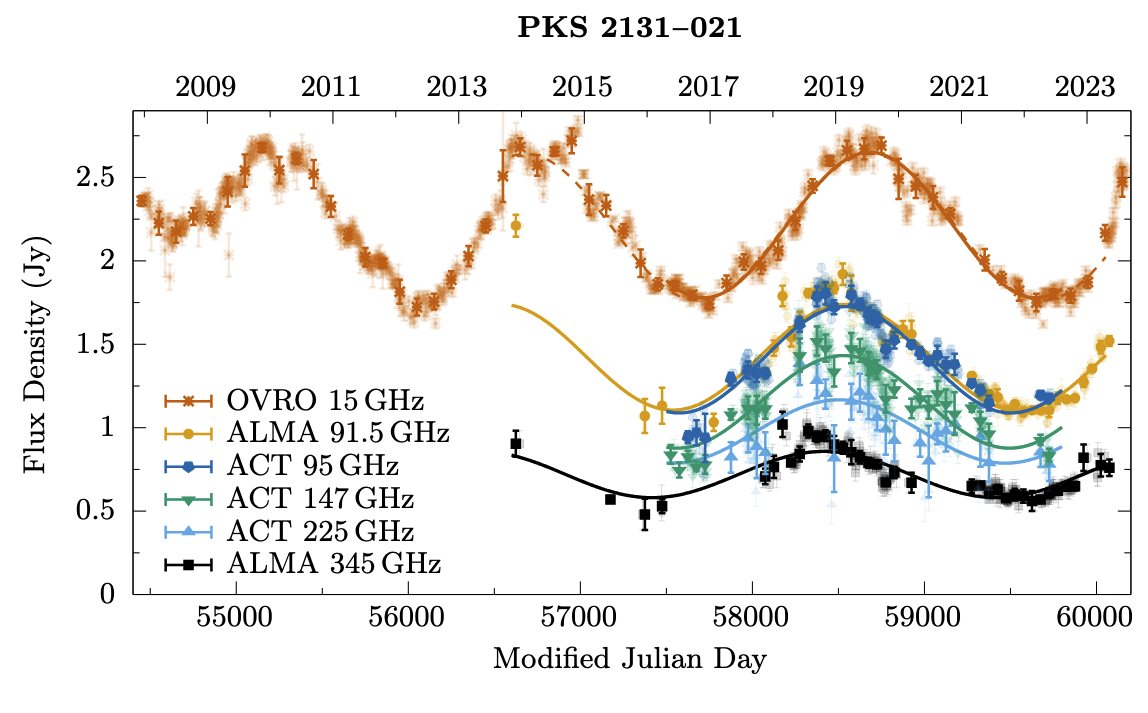
At longer timescales, our focus is primarily on radio blazars—relativistic jets powered by supermassive black holes. Because these jets are aligned with our line of sight, they produce a variable signal that reveals the dynamics of the galactic core. The enhanced Simons Observatory will assemble a massive public catalog of these light curves, with roughly 7,500 blazars expected to be monitored on a near daily cadence.
Blazar light curves also provide an exciting route to detecting supermassive black hole binaries (SMBHB), which have been suggested as the origin for the gravitational wave background. While standard blazars flicker randomly, an SMBHB would make the blazar brighten and dim in a steady rhythm, repeating over months to years.
Strong SMBHB candidates have already been detected in radio and millimeter data, including from the Atacama Cosmology Telescope, but the enhanced Simons Observatory could potentially detect hundreds more of these candidates. A wide-field and multi-wavelength census of these SMBHB candidates would significantly enhance the search for signals in the gravitational wave background observed by pulsar timing arrays.
Precision Cosmology from the Atacama Desert
Implementation of these upgrades is already well ahead of schedule, with the team having recently deployed much of the new hardware at a grueling altitude of 17,000 feet in Chile. When all is said and done, the upgraded Simons Observatory will open the door to a new era of wide-field millimeter-wave science. KIPAC researchers are at heart of these efforts, from deploying the hardware in Chile (check out fellow KIPAC member Toby Satterthwaite’s post for details from the field) to developing the analysis pipelines that will decode the data back home. With the key infrastructure falling into place, all that’s left is to wait for the Universe to show us something new.
Edited by Toby Satterthwaite, Lori Ann White, and Jack Dinsmore
Related People